
The Café tackled two contentious topics
A colleague came into my office years ago and after a long discussion about a project not going well said “we must grab the nettle by the horns”. Well the first nettle we grasped at this Café was the vexed one of terrorism and we debated the question ‘Is terrorism ever justified?’ With the war in Gaza still raging and Hamas (a proscribed terrorist organisation) still in existence, if weakened, it is clearly a debate of some moment. What is a terrorist? The Oxford dictionary says: ‘a person who uses or favours violent and intimidating methods for coercing a government or community.’ There is nothing benign in this definition and the idea that it can be used as a means of persuasion was clearly not in the mind of the lexicographer.
It was suggested the word emerged during the Iraq war (which is not in fact the case – it seems to date to the French Revolution and the period called ‘The Terror’). The distinction between violence against individuals in contrast to violence against a state was one of the first points made. It was important to distinguish between them it was said.
The word is more nuanced it was noted. Echoing the last point, there was a distinction between violence against property and and violence against people. This is a matter of some significance concerning the banning of Palestine Action following its latest action of spraying paint over RAF aircraft at Brize Norton. (This very weekend, over 500 were arrested for allegedly supporting PA at a rally in London). It was interesting that Just Stop Oil were heavily policed but never proscribed despite similar tactics used by PA. The contrast with the farmers was noted who blocked many streets in and around London as part of their protests. There is no record of a single farmer being arrested.
The suffragettes were mentioned who used violent and aggressive means to force the government to accept female enfranchisement. It followed many decades of peaceful protests by the suffragists which were largely unsuccessful. The word suffragette was coined by the Daily Mail as a term of disparagement. Misogyny has a long history in that paper clearly.
Historically, the words ‘Freedom Fighter’ was often used for such activities but in recent times, terrorist seems to have taken over.
The frightening effect of protests by supporters of Palestine on Jewish communities was claimed.
The lack of democratic credentials was pointed out. It is perhaps difficult to see how a democratic process could be organised to support a terrorist organisation however. Neither the UVF or the IRA had any kind of formal democratic process in their formation. Later in the discussion it was said that terrorism exists when/where democracy has failed. This observation cropped up several times.
The debate shifted a gear by asking can a state be a terrorist organisation with its own activities against its own citizens? Russia was mentioned. President Bush called a range of states an ‘Axis of Evil’ (Iraq, Iran and North Korea) for supporting terrorist activity beyond its boundaries. Governments can introduce laws which aren’t democratic. A state can demonise a cause they don’t like by calling it ‘terrorist’ a technique now widely applied around the world. In any event, who gets to decide on these definitions?
We were reminded of the activities of the US in South America where nation after nation was threatened and its leaders murdered or overthrown if there was any sign of them becoming socialist or communist. In Chile, the murder of president Allende and his replacement by General Pinochet was given as an example of the role of the CIA.
Do our definitions change if there is a war? During the Second World War, the French mounted a ‘resistance’ against the Germans. Would we call their activities terrorism? We didn’t because we approved of their resistance and the SOE supported them with their activities. Following the invasion of Afghanistan by the then Soviet Union, the US supported the mujahidin. Subsequently, with the occupation by the US they were fighting the same people whom they had armed and trained. Who or what is a terrorist seems to shift according to whether we approve of them or not.
It was suggested that any country which has a secret service is by definition a terrorist state. An interesting proposition. Perhaps a country which invades another can similarly be described. This led to a discussion of ‘justified’ and how that could be defined and also ‘proportionality’. This latter being discussed in relation to Israel’s actions in Gaza. A key issue someone thought was when violence was used against civilians, the problem of Russian’s bombing Ukraine an example. Nelson Mandela was mentioned who was involved in the bombing of unmanned government buildings and was declared a ‘terrorist’ by President Reagan. One man’s terrorist …
We were reminded that the UN allows the use of force against an invading nation.
The discussion moved on to whether we should negotiate with terrorists. Northern Ireland was mentioned and the covert negotiations with the IRA. An interesting point was made: if there was some ‘right’ in the terrorist’s position then perhaps negotiations might be justifiable. There was an obvious danger of course, namely if anyone with a cause imagines that violence is a passport for negotiations then the results can only be imagined. Was there some kind of ‘sliding scale’ of justification for political violence? it was asked. At this point the book How to Blow up a Pipeline was mentioned which argued for aggressive approaches to climate change. Hamas was mentioned and it was claimed that they seek the extinction of Israel and are called terrorists. Israel seeks the destruction of Hamas and Palestine but are not called terrorists. [The BBC says Hamas is opposed to the existence of Israel which may or may not mean the same thing].
We struggled with the word ‘justified’. Can the killing of civilians ever be justified? In Gaza it is the disproportionate nature and scale of the IDF attacks which many are concerned about.
Definition came up several times. When a group is defined as a ‘terrorist’ organisation then governments stop negotiating with them. Understanding the underlying causes also disappears from view.
Finally, this week was the 80th anniversary of the dropping of the first atomic bomb on Hiroshima. Was that an act of terror by one nation on another? We did not explore that unfortunately …
A difficult topic suffused as it is with meanings, politics and perspectives but an interesting discussion nevertheless and one worth exploring.
The next topic was almost as controversial as the first namely, should the City Hall invite Katie Hopkins (pictured) to a gig at the hall? It appeared that some in the audience had not heard of her which is a kind of comment in itself. She came to fame on the BBC’s Apprentice programme and has since carved out a career for herself as a media person with a range of outspoken views. She deplores fat people and seems to have particular animus for women who stay at home after having a baby (having looked up a range of her quotes I discovered). The argument was essentially about the cancel culture which has gripped the universities. Some of her gigs have been cancelled it was claimed largely on public order grounds apparently.
Did the booking and the purchase of tickets mean her views were endorsed by the hall and the
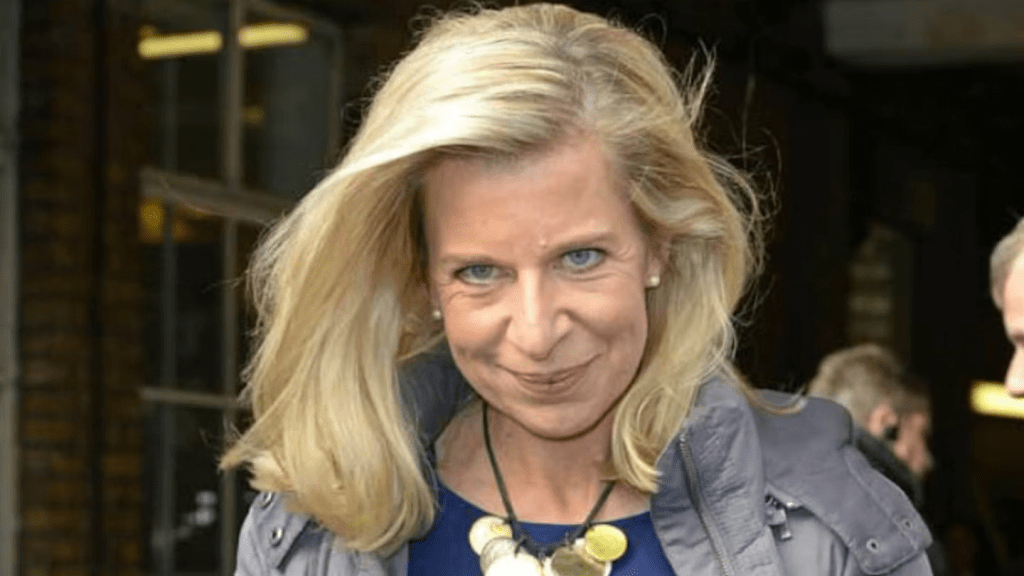
audience? Some of the arguments hinged on KH being classed as right wing. It was a pity that more did not know of her comments because although they are, some might argue objectionable, few seem to be particularly right wing. The view that she was led to a question about whether a left wing comedian (Stewart Lee was mentioned) should be cancelled?
It was argued that the City Hall was simply doing it for commercial reasons. One article was mentioned which caused much anger and many complaints was in the Sun where she referred to migrants as cockroaches. Objecting to her presence could be argued on acceptability grounds. It was divisive and these comments go against the values of our society. It was strongly felt by some that the City Hall should not be making money by inviting people whose act was built on causing offence.
The counter argument was should we be concerned at offending people. Shami Chakrabarti has claimed that in the interests of free speech, we do not have a right not to be offended. Stand-up is sometimes outrageous, so where do you draw the line? The popular and award winning series on the BBC The Hour has been pulled and back issues are no longer available. It appears because it had low ratings rather than for any political or acceptability reasons (why back issues are not available is a puzzle though).
In connection with a Tommy Robinson video, said to be professional, persuasive and manipulative, it was suggested that the educational system needs to catch up. There was a need for critical awareness to be introduced into Civics classes to help students grasp meanings and impacts. The Super Searchers Programme has been launched to enhance information literacy. However, it is run by Google – draw your own conclusions. An article in this month’s Byline Times discussed the topic of information with the familiar misinformation and disinformation, which we have discussed in several cafés, but added a third, malinformation which is using correct information for malign purposes.
A point was made concerning humour and its use to mask prejudice. An article by George Monbiot in he Guardian discussed this aspect of humour by individuals like Rod Liddle who has a column in the Spectator. The article suggests that humour can be used as a form of ‘plausible deniability’ and as a cover for outrageous views such as getting rid of disabled people by starving them to death. Rod Liddle suggested bombing Glastonbury for some reason. Monbiot makes the point about Right v. Left: if a humourist suggested bombing the Conservative party conference there would be outrage. Suggestions of bombing Glasto are, well, humour. Can’t you take a joke?
It was noted however that Bernard Manning made a career out of being outrageous and was hugely popular.
An interesting idea was put forward about comedy: it is acceptable punching upwards at the powerful, less so punching ‘down’ to the powerless. Where that puts Bernard Manning’s many jokes about mother-in-laws is for you to decide.
This was an example where debate could not settle a basic difference of view. For those who dislike unpleasant or divisive views being aired – whether or not wrapped up in humour – the likes of Katie Hopkins should not be promoted certainly not for profit. For others, however unpleasant, such people should be heard because the risk to free speech is a higher cause and one where we just have to put up with unpleasantness in its cause.
Peter Curbishley
The next meeting is on Saturday 13th September starting at 10:00 for 2 hours. We are grateful for the Library allowing us to use their space.
 Salisbury Democracy Alliance