Blog

  • Second Talkshop event held today

    The second of our Talkshops was held today (27 May 2023) in Brown Street and three possible projects may emerge

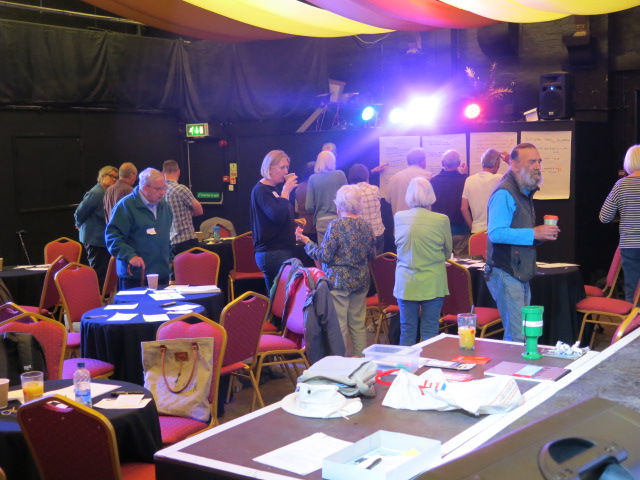
    About two dozen attended this morning’s session in Brown Street and three projects emerged from the 40 or so ideas which were proposed. The idea is that ideas that have worked elsewhere in the country or the world are posed as possible ones for the authorities of Salisbury to consider. It was encouraging that three councillors from Salisbury City Council attended and joined in.

    We will then take these raw ideas and see if we can turn them into workable projects for the City to consider or even carry out.

    Recent events, particularly in regards to national politics, has left many with a sense of despair. How can the affairs to the country be so badly mismanaged by a group of people who appear so detached from reality and seemingly with little sense of integrity or capability? In a humble and modest way, the Talkshop might offer a means for real and meaningful involvement of the community in the running of our affairs, certainly at the local level.

    As we take the ideas forward we will post further details soon. We are grateful for the involvement and help of the RSA.

    One disappointment was that we had 40 people express interest in coming to the event but a sizeable number were ‘no shows’ on the day. Bright sunshine and a warm day might just have had something to do with it!

    PC

    Pictures show members of the Talkshop discussing the topics and reviewing the ideas on flip charts.

    Photo: Neil Beagrie

  • Citizens’ juries

    Exchange of correspondence on the issue, and cost, of Citizens’s Juries

    If there is one thing that is guaranteed to get people agitated is the issue of tax and its related topic, community charge. A key promise by politicians of all shapes and sizes – almost always broken – is that they will keep such taxes low or at least not raise them. They also promise to do this and that policy to improve our lives which usually requires, in some form, er … tax. We will tackle waiting lists (but not raise your taxes), we will sort out the pot holes (but not raise your community charge), we will improve … well you get the idea (but not …).

    I claim no scientific basis for the following but it seems to me that people respond to this issue in one of three broad ways. Firstly, there are those that say ‘they don’t mind paying more tax as long as it’s spent on X’ where X is something they favour e.g. the health service. This is the hypothecation view and it has many problems one of which is different people favour different things they want taxes to be spent on. How do you decide?

    The second group is ‘I wouldn’t mind paying more tax but they only waste it’. ‘Waste’ here can mean many things but it often means, on enquiry, money spent on things they don’t approve of: in the current climate that will be hotel accommodation for the boat people.

    Finally, there are those that believe that lower tax means everyone is better off. It overlooks the simple fact that yes, you can buy some new clothes or go out for a meal or two with the money saved but you can’t buy yourself better roads, a health service, defence and all the other things that make life bearable. Some things just have to be done collectively or they won’t get done at all. Tax is our contribution to a good society.

    So this is part of the backdrop to an exchange of letters in the Salisbury Journal. The Parish Poll conducted by Salisbury City Council recently has produced a huge amount of correspondence and in turn led Cllr Charles McGrath (Con) to write on 27 April, complaining about the conduct of the poll which voted for a cap of 5% on the precept. He then says “This is the administration that pledged to make ‘Your voice Heard’ in their Strategic Plan for Salisbury City Council, and once supported the concept of of self-selecting Citizens’ Juries which have cost some councils £40k – over twice the amount of a parish poll” (our italics).

    This week (4 May) Dickie Bellringer, a member of SDA, replied […] “I would like to correct a piece of misinformation disseminated by Cllr Charles McGrath in last week’s postbag the citizens’ juries are self-selecting. This is untrue. Citizens’ Juries are examples of deliberative democracy for which residents are selected randomly in order to deliberate on important local issues.

    “They can draw on, and interrogate expert witnesses who will provide information.

    “[…] Cllr McGrath writes that Citizens’ Juries have cost some councils £40,000 but Salisbury Democracy Alliance has been campaigning for Citizens’ Juries for many years and, by working with local partners, should be able to produce a Citizens’ Jury for less than £18,000”.

    He finishes by referring to the Talkshop event mentioned in our last post, which takes place on 27 May.

    The idea of letting people’s voices to be heard is a familiar one but few are in possession of the time or expertise to make significant contributions. There is a need for advice, and time for people to digest and understand the complex issues around a local economy. The Strategic plan – referred to by Cllr McGrath – is my view flawed in many respects. See the link above. I wonder how many will have read all the reports and supporting material? Whether it’s £18,000 or Cllr McGrath’s exaggerated £40,000, isn’t it better to find a way to sound and achievable solutions than following the path of a somewhat flawed plan?

    But the backdrop is always the issue of tax and how much we should pay. Politicians are never able to say that lower taxes do not automatically make you better off. The years following austerity has seen spend on a wide range of public services and local authorities decline precipitately with the results we are now witnessing.

    Peter Curbishley

  • Talkshop: UPDATE

    This is the second post about our second Talkshop due to take place today, 27th May starting at 10:00 at 29 Brown Street Salisbury finishing at 12:00 prompt. Most of the places are now taken so if you are interested in coming and taking part, you do need to book straight away. It is free but we ask for a parting collection to help with our costs.

    The event is run in partnership with the RSA and we are grateful for their help. This is our second event of this kind and the first help spawn the EcoHub project which is now doing well and has a site in the Market most Saturdays.

    The event is part of the Alliance’s efforts to see citizens more involved in the politics of our community and to try and get a higher standard of decision making. We are pleased that some councillors are planning to come which might help secure ideas such as citizen’s assemblies become a feature of how decisions are made locally.

    The event will be run much as before. We assemble in small groups of around 6 each and examine a range of cards with ideas where citizens have been involved in the democratic process. After discussion, each group will select 2 or 3 which they think might be of use and relevance locally. During a break, we look at other team’s efforts and come up with some final ideas. It’s both fun and has a serious intent.

    One of our aims is to move away from so-called ‘consultation’ exercises where plans and policies are presented for us to look at but where in fact decisions have largely been taken and other options may not even have been looked at.

    Interested? Then you need to book up using the following link:

    https://www.eventbrite.co.uk/e/new-local-politics-involving-citizens-in-local-decision-making-tickets-597656295067

    May we please ask that if you do book and are unable to come, to let us know so your space can be offered to someone else. Thanks. See you there.

    Photo: SDA

    We also run the Democracy Café which meets once a month in the Library. The next one is May 13th and starts at 10:00 am and finishes at noon. If you scan this site you will find reports of our previous meetings and the sorts of things we have discussed.

    PC

  • Second Talkshop event

    We are please to invite you to the second of our TALKSHOP events in collaboration with the RSA at 29 Brown Street between 10am and noon on Saturday 27 May. Last year’s event was very successful and resulted in the creation of the Eco Hub who have a presence in the Market Square.

    This time we will exploring how we can do politics differently in Salisbury and how we can engage more citizens in our local democracy. Participants will be given examples of how politics can work differently both from the UK and throughout the world and select some ideas that are achievable locally. You can find out more by clicking on the link above.

    More details will be provided soon.

  • Democracy Café, April

    April 2023

    Despite it being Easter weekend, we had a good attendance at this meeting in the Library and we were pleased to welcome two new participants. We had two interesting debates and we could well have gone beyond our allotted time.

    The first was Is representative government truly democratic? We started with the famous President Lincoln quote of 1863 after the battle of Gettysburg: ‘government of the people, by the people, for the people shall not perish from the earth’. The problem is the combination of representation and democracy, two concepts which do not necessarily fit together. Apparently, it was Robespierre, who met an untimely end, who combined these two ideas. We were also reminded that Plato’s idea of representation was to limit it to those who were capable of reason.

    Brexit was an example of representative democracy it was pointed out and the result was it did tie the hands of the government to this decision (for good or ill). This immediately brought up the point that in our electoral system: MPs are representatives of their constituencies, not delegates. But who, it was asked, is being represented? The assumption that it was the ordinary elector is unrealistic. It was the wealthy and corporate interests who really held sway [the debate took place in the week when a Conservative MP was caught in a sting by Times’ reporters offering to sell his services to a fictitious gambling company for a fee of £10,000. This came a fortnight after two ex-ministers were caught in a similar sting].

    It was further suggested that the premise was wrong: MPs are selected not elected. The ‘elective dictatorship’ of Lord Hailsham was mentioned. Some have been groomed for some years for senior positions in their parties. This linked to the comment that historically, MPs were older whereas nowadays they had little of no real work experience outside the political milieu. They left university and spent their years in the Westminster environment before becoming an MP.

    The general tone of the discussion was a sense of dissatisfaction with our politicians but it was pointed out that a lot of good work was done in parliament – evident if you read Hansard – but this was almost never reported. We only read of the conflicts and scandals.

    We moved on to voting and the Australian rule that everyone had to vote. The counter view was that if people don’t want to vote why should they be forced? It was a dilemma. Belgium was mentioned in connection with MPs becoming part of the executive so who then do they represent, their constituents or the government? In that country, if the equivalent of an MP becomes a minister, they resign their seat and and there is a by-election. If they are sacked one assumes they leave the government altogether … [now there’s an idea]. Later, the question of voter apathy was mentioned.

    Do people vote for the individual or their policies? Some said the former; some the latter. It was suggested that parliament is a reflection of our views, the collective zeitgeist so to speak. We had a diversion into what Andrew Bridgen MP said in parliament and this link gives the background to that. It concerned claims – since retracted – about the risks and effectiveness of Covid vaccines. The attempt to introduce equal pay for women by Barbara Castle was mentioned where attempts to introduce it were frustrated by what was thought to be the will of the (male?) public. It was suggested that women do now have equal pay. Legislation introduced by Theresa May requiring companies with over 200 employees shows however, that women definitely do not receive equal pay for equal work.

    What we know is mediated by the media – a familiar point in these meetings. The necessity for good information was stressed and the need to hold the media to account: the issue of social media was mentioned which is largely unregulated. Inevitably, all information was filtered and imperfect it was noted. Information was about power and the process of infantilization, i.e. keeping us (the public) away from the real decisions by deflecting us towards things that don’t matter was suggested. Different countries had differing approaches and the current unrest in France demonstrated that country’s approach to political change which was often violent. The ‘British don’t go on marches, instead we go on shuffles’.

    At several times there was the suggestion that decisions should be made at the lowest level in the political process and in that connection, Flatpack Democracy in Frome was mentioned. A post from 2017 reports on the talk given to the Compass group gives more details.

    But back to the question and that the melding of democracy and representation was imperfect and sometimes muddled. It was sort of assumed that they were much the same and as we have debated, who represents us, how they are selected (or elected) and who they actually represent is by no means clear and whether it gives us ‘democracy’ is perhaps to be doubted. The need for a constitution was suggested but this point was not developed.

    The fact that Switzerland holds regular referenda was mentioned.

    Finally, a Channel 4 programme about a hotel in a village being occupied by asylum seekers was mentioned as a kind of example which reflected some of the points we discussed. A hotel had been block-booked by the Home Office to house a significant number of refugees and asylum seekers. There had been no prior consultation. The village was split: some were hostile some were sympathetic. It shows the problem of democracy in that how do you represent such profoundly different views? Whether it’s representation, a referendum or any other form, there are those who are fierce in their antipathy and those who are not. It wasn’t about what system therefore, it was about people and their attitudes.

    Which segues nicely into our second debate which was What are the benefits of Brexit? Well, it has to be said that there were few put forward. The news this week was of long queues at Dover because, it was thought, to be the result of the need to stamp all passports now we have left the EU although this was denied by the government.

    One argument was the failure of some banks in Europe in particular Credit Suisse although it was pointed out that Switzerland was not in the EU and some American banks had failed as well. The Swiss bank failed because of mismanagement and it had little to do with the EU. The nonsense of Greece being treated the same fiscally as Germany was mentioned which led to a crisis in that country.

    “Now we left the EU we can no longer go on blaming them for everything, now it’s us”.

    One profound point was made and that was we can no longer blame the EU for our troubles. We had got into the habit of blaming the EU so now we have left, that excuse is no longer available. Perhaps it was an opportunity for the country to grow up. Governments have always tried to deflect bad news elsewhere to detract from their own failings.

    A big benefit for Brexit was said to be sovereignty and the slogan ‘take back control’ was a key rallying cry during the run up to the Referendum. The argument was that we were in hock to ‘unelected European judges’ rather ignoring the fact that European judges are elected and UK ones aren’t. It was quickly pointed out that our decision to leave demonstrated we did have sovereignty. The judicial system is not part of the EU.

    Walter Lipman’s quote about the bewildered herd was mentioned again – see the January Café. In that connection the speaker went on to refer to the purchase by JP Morgan of 25 of the most influential newspapers in the US in 1917 in order to influence the decision to get the country to enter the European war then raging. The point being how the media, or more particularly the owners of media, can influence debate, attitudes and decisions in a country.

    A lot of subsequent comments focused on the benefits of EU membership and the EU generally. For example, Europe has been riven by wars, certainly since the fifteenth century, including two major world wars and one lasting for almost a hundred years. Yet since the last war, Europe has seen the longest period of peace in a millennia. [Ukraine was not mentioned but that is not a war between two or more European states].

    Historically, France had a system of internal tariffs introduced by the ‘July Monarchy’ in 1830 as people moved from region to region. When these were abolished, everyone prospered. Several noted the ability to move around the continent once free movement was introduced (back to the queues at Dover). Free movement and free trade benefited the ordinary people it was suggested.

    It seems that some people are beginning to change their minds. The government (even if they wanted to) would find changing theirs extremely difficult. Will we ever be able to have an honest discussion someone asked and perhaps be able to admit we were wrong?

    A possible benefit, following the shortages of salads imported from Europe, was an increased interest in self-sufficiency.

    And whatever happened to the £350m that we will save by no longer being members of the EU? This had to remain an open question.

    There was a brief discussion about the role of the City of London.

    Two interesting debates and actually linked in many ways. The need for informed decisions was crucial for good government. When a poorly informed populace elected MPs, some of whom had been selected for them, a media which was partisan, an unregulated social media and a government which was heavily influenced by commercial and corporate interests, it was perhaps a wonder we weren’t in a bigger pickle than we are.

    Peter Curbishley

    An interesting take on democracy and the Brexit debate is Peter Geoghan’s book Democracy for Sale: Dark Money and Dirty Politics, 2020, Head of Zeus Ltd , which is well worth reading.
  • Progress meeting

    Notes of a committee meeting to discuss progress with our various plans

    March 2023

    Eight of us met this week to discuss progress and make plans for forthcoming event. This is to keep the wider membership in the picture and is not meant to be an authoritative minute of the meeting. Also present were three members of RSA.

    Talkshop

    The main topic of conversation was around the next Talkshop event and we spent some time reviewing 60 cards with suggestions and possible projects. Some were of limited relevance to Salisbury but we still managed to identify two dozen possibles from the full list. After lengthy discussion we boiled it down to 4 possible topics:

    • Trying to include the voices and views of the ‘unheard’. These are people who are marginalised, who do not feel politics is for them, that their views are unwanted or who simply cannot engage because they cannot get out in the evening for example.
    • Involvement in the budgeting process. This might be ambitious since local government financing is highly technical and heavily constrained by Treasury rules. It was once said that only four people in the country understood local government finances and one of those was dead. It is worth serious consideration however as what is in the budget determines what does and doesn’t get done. And why shouldn’t citizens be involved?
    • Citizens’ juries and the need for: hardly any need to expand on this as it is our raison d’être.
    • Involving young people. It will be the young who inherit what we do now and their world is quite different from the generations which went before. Yet they are seldom seen when decisions are taken.

    We then spent some time discussing invitees which will include local politicians, Area Board people, Chambers, TUs. We discussed publicity and it will include posters in schools, the WCA newsletter, Transition City and no doubt others will be added at the planning stage. It will be a ticketed event.

    The objective was agreed: ‘to develop a set of policy objectives or projects involving local people and which could be implemented by Salisbury City Council and if necessary, Wiltshire Council’.

    It will run in Brown Street on May 27th from 10:00 ’till noon prompt.

    Planning

    It was brought to the group’s attention that in the last edition of The Planner, the journal of the Royal Town Planning Institute, there was a leading article on the subject of community involvement and citizen’s assemblies. It is likely that officers in WC planning dept. will have seen the article and it was agreed we would write to the head of planning suggesting a meeting to discuss. Update: letter sent 18th March copy below.

    Local Plan

    Consultation on the local plan was well underway and it was queried whether we should make some kind of response. The plan was well advance it was noted and it was suggested there were a number of shortcomings which will make its implementation problematic. See an earlier post and see also a response to our letter lamenting the lack of a citizens’ assembly during the preparation phase.

    Eco Hub stall

    We shared a stall in February in the Market Place and the results were a little disappointing. For next time the lessons learned were: sharing a stall does not work; there were too few flyers and we need something similar to the Brexitometer run by Salisbury for Europe that is, a board with options or questions to engage passers by.

    People in the Park

    Whether we should have a stall at this event again was discussed but the cost of insurance – which exhibitors have to pay themselves this year, means it is no longer viable.

    Democracy Café

    The last café was run the previous Saturday in the new venue in the Library. This had been a success although if numbers grew too large it might be a problem. The next meeting is on 8 April. A report of the last meeting can be read here.


    Generally we felt it had been a worthwhile meeting and plans for the second Talkshop look exciting. The next planning meeting is on 18 April at 14:00 probably in Brown Street (to be confirmed).

    PC

  • Democracy Café, March

    March 2023

    This was the first meeting in our new home at the Library. It turned out to be a good location with no distracting noise and of course it is central.

    The first topic was almost a forgone conclusion: namely, Gary Lineker who was the subject of a major row. Gary is the presenter of the BBC’s Match of the Day and following the announcement of the latest bill by the government to deter refugees travelling by boat across the Channel, declaring them automatically illegal, had tweeted “An immeasurably cruel policy directed at the most vulnerable people in language that is not dissimilar to that used by Germany in the 30s.” This had prompted his suspension from the programme and as the other presenters decided not to appear meaning the programme would have to be aired without a presenter at all.

    A large number of points were made in what turned out to be an interesting debate. The first point was that he was freelance and not a BBC employee. As a sports presenter, he should be free to express his political views as a matter of free speech. If he had tweeted his support for the government’s proposals, what someone wondered, would have been the reaction?

    The view was expressed that celebrities from other realms of work should not be allowed to express their political views (this did not receive much support).

    The BBC’s view was even though he isn’t a political commentator, he has an enormous following and is thus influential.

    An important point was made that this whole row had acted as a distraction to the real issue namely the immigration and asylum system itself and the failure of government policy to tackle this issue adequately. Was the bill merely theatre someone wondered? The government knew it wouldn’t work it was suggested but just wanted to show that they were trying to do something knowing it had little chance of becoming law. Someone who had met the local Conservative MP in the past few days reported he did not think his party to be in power after the election which might support this view. Greg Dyke, former DG of the BBC, was quoted as saying in an interview that he thought the BBC was mistaken as it gave the perception they had bowed to government pressure.

    A feature of the debate – and a key element of Lineker’s tweet – was the issue of free speech. It was noted that Lineker did not use the word ‘Nazi’ that some commentators and politicians had accused him of. Was the range of recent bills inhibiting protest and limiting access to judicial review, together with attacks on the BBC in general and Lineker in particular, signs of growing authoritarianism a la Germany in the ’30s? Was the reported decision, also by the BBC, not to broadcast the final episode of the forthcoming Attenborough series because of a fear of a right-wing backlash, a further example of a creeping curtailment of free speech?

    It was noted that over the past few weeks, Jacob Rees-Mogg, Nadine Dorries and Lee Anderson, all currently serving as Conservative MPs, had been given their own shows on GB News. They will be free to air their views every week yet there has not been an outcry about their appointments or conflicts of interest. We were also reminded of the scandal surrounding the appointment of Richard Sharp as chair of the BBC following his substantial contribution to the Conservative party and his failure to declare to the selection board his role in securing a major loan for Boris Johnson, prime minister at the time, who subsequently appointed him.

    The debate moved on to the issue of impartiality and was true impartiality ever possible anyway? There is a legal case at present where the views of Fox News presenters appeared to different from those aired during the Trump era. This aspect of the debate arose around the question of ‘balance’ which sat alongside ‘impartiality’ at the core of the problem. Climate was an example where the BBC balanced reporting of climate change by inviting speakers who did not accept global warming to debate with scientists who did. This resulted in a false balance since the ‘deniers’ had little science to support their views. After a prolonged outcry, this no longer happens. On the other hand, employees of local government, government departments and agencies are not allowed to engage in political activity or air their views on these matters in public.

    Linked to this was the failure by broadcasters to ask who was funding some of the people they interviewed. Some contributors were funded by fossil fuel interests which was not declared to the listening or viewing public.

    Hard to sum up but there was a feeling that it was important for commentators to be free to air their views. There was a simmering sense that with the foreign ownership of our media and with hostility towards the BBC (and we might have added Channel 4) we were at risk of losing key elements of free speech and a slow drift towards a one party state was not impossible. The first thing the BBC should do someone suggested is not follow what the government says.

    In the second half we attempted to tackle the question who runs Britain? You cannot say we lack ambition.

    The first theory out of the blocks was it was all rooted in money. The City and other interests were focused on this aspect. It was money which gave you power someone said. Second was the influence of public schools and their desire to maintain their influence in society and, it was claimed ‘to keep at all costs, the socialists out [of power]’. They devoted great efforts to maintain their role in society.

    The media was mentioned on the basis of ‘who controls the media controls the message’. Whether that is so true today with such a diversity of platforms is to be questioned. We were then introduced to the Beckhard and Gleicher’s change formula – which is probably the first time a formula has been introduced into our proceedings – and that is (D x V) + FS > C where D is dissatisfaction, V is vision and FS, first steps. Latterly, the C component has been replaced by R representing resistance to change. If the first set of factors is greater than the second, change might happen. To note is that if any of the left hand terms are zero, there will be no change.

    Corporations were another source of power and the multi-national ones in particular. Not all were venal it was pointed out and some did want to improve the lot of their fellow man.

    China was mentioned and the role of Deng Xiaoping who, following the death of Mao, told the Chinese to ‘go out and make money’. This led a discussion of the seemingly impregnable one party states like former East Germany and Romania which, despite having formidable security apparatuses, collapsed quickly following modest protests. Would China be like that despite their highly sophisticated surveillance system? Their swift change of course on Covid lockdown in the face of protest was noted. However, the failure of the Arab spring demonstrated that not all protests and uprisings led to happy results – look at Egypt.

    One of the paradoxes of politics today in relation to who runs the country, was the fundamental belief of the current government in less government following the neoliberal agenda. They believed in freedom and the ebb and flow of markets to decide matters, not government interventions. Well that was the theory.

    Two debates which circled freedom of speech and good government. The first focused on a specific incident and a tweet by Gary Lineker, the second on the more general issue of where the power lies in our country. The support Lineker received, while we were debating this issue, and resulting in the disruption of the BBC’s sports coverage, perhaps demonstrated that power can often be illusory and hard to control.

    Peter Curbishley

    Book mentioned: Another Now, Yanis Varoufakis, 2020, Vintage

    Of relevance:

    Who Governs Britain? Anthony King, 2015, Pelican

    Posh Boys: how the English public schools run Britain, Robert Verkaik, 2018, One World

  • Next Democracy Café

    Next Café and note change of venue to the Library

    Today!

    Following the closure of Progress café we have relocated Salisbury Democracy Café to Salisbury Library. So, the next café on Saturday 11 March between 10am and noon will be held in the Portico Gallery on the first floor at the front of the Library. We will normally be in The Lounge area but, unusually, this is occupied on Saturday. Tea and coffee will be available and you are welcome to bring your own mugs if you wish. However, biodegradable paper cups will also be available as well as the library’s own mugs. Hope to see you there.

    DB

  • Democracy Cafe, February

    February 2023

    Some cross-over in the topics put up for discussion today but the first one chosen was How important would it be if the UK withdrew from the European Court of Human Rights? This desire is one put forward by several Conservative politicians and some cabinet ministers including the Home Secretary, Suella Braverman. It became a hot topic when the Court overruled the intended deportation of immigrants to Rwanda.

    The proposer said that it was a threat to our rights. We had signed the Universal Declaration in 1948 and subsequently, the European Convention of Human Rights. Withdrawal from that risked us becoming a ‘tiny little country’. It was all part of Brexit and the idea of ‘taking back control’ particularly our borders. The current government didn’t want anyone telling us what to do. This was particularly relevant in the context of the channel boat crossings. If we left the ECtHR it would give the government more power and the citizens less.

    A counter view was that the UN Declaration and the ECtHR were both mistaken since it gave states the legitimacy to remove them (our rights). Our rights came from God it was argued.

    Concern was expressed over the power struggle with our relations with Europe. There was a kind of ‘thuggishness’ in our government at present, not just around the bullying allegations against the Justice Secretary, Dominic Raab (which are denied), but the aspect of our role with Europe and the desire to leave the jurisdiction of the court. There was a kind of desire to appear strong. They were keen to show themselves to be above the judges and were seemingly happy to engage in battles with the Good Law Project. That it was a Conservative, Winston Churchill, who was a moving force in the signing of the UN Declaration seems to have been forgotten by some members of that party. We were reminded that the justice system was in crisis at present with massive waits for cases to be heard.

    It was pointed out that we got the Human Rights Act because the government was constantly running into problems with the court in Strasbourg. They were overturning decisions by our courts which was proving embarrassing. People seem to have forgotten that our judges were quite reactionary. Examples included rights for disabled people and the right of elderly people to live together in a care home where the decisions of our courts were overturned.

    The discussion moved on to discuss the Shamima Begum case. She was one of the three girls who fled to Turkey, thence to Syria, to join ISIS. The debate was around did the government have the right to remove her citizenship and to make her stateless? She currently lives in a camp in Syria. One view was that we should not be concerned about her welfare: she went of her own accord to join a murderous and fanatical group. What happens to her now was on no consequence.

    Others pointed out that she was an immature teenager when she left and would have been easily misled. She had become the object of a media hate campaign. Would it not be better to accept that she has British citizenship, to bring her home and put her on trial? Another suggestion was to send her round to schools to explain the severe results of doing something such as she did?

    This case – and our earlier discussion – both brought up the role of the media in generating negative ideas about the European Court and cases like Shamima Begum. Was the fact that she was a person of colour important in her demonisation someone wondered? It was important someone stressed, that rights existed for people you don’t like as well as those you do.

    This discussion drew to a close with some remarks about our media, with their predominantly overseas ownership. Our rights were hard won over centuries (yes, Magna Carta was mentioned) yet there was a libertarian trend, promoted by some of the foreign media owners, who wanted more deregulation and who believed in increased libertarianism. It was these beliefs which led to the Grenfell Tower tragedy it was suggested. It was pointed out on the other hand that the print media was in danger of losing touch with younger readers in particular who no longer bought papers and often did not agree with their views.

    We then moved on to discuss the question Do we need more immigration? a matter which arouses considerable controversy at present. The question was posed in the context of large numbers of European workers having left because of Brexit and sometimes because of the hostile environment. Many of those who came here were not allowed to work.

    The economic argument was put forward namely, that British firms had relied on cheap labour, whether indigenous or imported, instead of investing in new kit and skills training. Corporate welfare was mentioned which meant that firms externalised their costs and employees were receiving benefits from the state and some were forced to use foodbanks.  It was not just low investment but economic uncertainty which also contributed to our economic problems.

    Was the nation’s attitude a reflection of being an island nation it was asked?  Other nations had borders which had moved over the centuries with mixed populations.  Britain was an island so its borders were fixed.  This had engendered an ‘island mentality’.

    The contrast in speaking to people whose family members had emigrated and the pride they expressed at their success and evidence of enterprise and ‘get up and go’, with attitudes towards those who came here was interesting. If our people go there, it’s good. If they come here, not good.

    Adam Smith’s Wealth of Nations and the need to frighten people to work was brought up.  However, it was noted that the number of registered disabled had increased significantly so that, it was claimed, something like 20% of the working population was so designated (this figure was disputed). Many people suffered chronic illnesses it was said.

    The discussion moved on to other issues to do with the labour supply and mobility was mentioned. We needed more labour mobility, both nationally and internationally: people needed to go where the work is. Some of the barriers are the housing supply and frictional costs in moving, and affordable childcare.  Significant numbers of older people had left the workforce as a result of Covid but many had not returned.  Perhaps training to encourage them back might be a solution.  It was harder for older people to return however.

    Should we in fact promote emigration?  A period working abroad could be an attractive option for many. 

    Two interesting debates, both connected with our attitudes towards the outside world.  They concerned a widely held and suspicious view of Europe closely connected with a fear and hostility towards immigrants.  Our ‘island mentality’ has no doubt played a part.  But it was interesting that just over half a million Ukrainians and people from Hong Kong have come to the UK almost without anyone noticing, whereas the 40,000 boat people had generated considerable anger and almost frenzied media attention.  That seemed to point to a basic humanity which still exists in contrast to the hostility which grabs the headlines.

    Peter Curbishley

    Venue. There are some issues about out venue but we hope to know more before the next meeting on 11 March. Details will be posted here.