February 2025
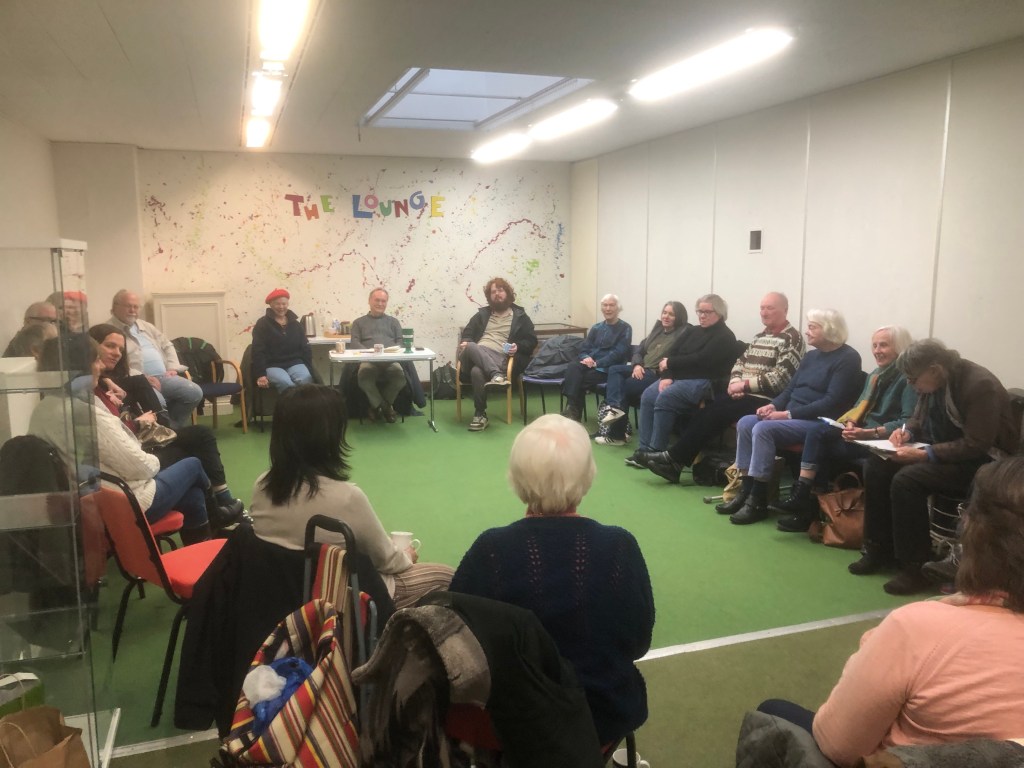
Largest assembly for the Café since its formation
The room in the Library was full for our café on 8th February and we discussed two quite unrelated topics. But first, it is timely to thank Salisbury Library for giving us this space. Libraries have had a tough time in recent years with one report saying 180 have closed since 2016. We much appreciate them for enabling us to meet there.
There were a large number of topics suggested (around 16) and the one which won the most votes was How do we get growth, and do we want it? This of course arose following speeches by Rachel Reeves and Sir Keir Starmer who have nailed the Labour party’s flag to the growth mast as the solution to the country’s many ills. ‘To believe in growth on a planet with finite resources is either a madman or an economist’ thus spake David Attenborough. The third runway idea seemed to ignore environmental issues which appeared at one time to be an important element of Labour’s policy. But how to change the narrative was the question. The assumption that growth was the answer to problems is almost assumed wisdom without it ever being questioned.
The idea of a third runway at Heathrow was unlikely to be successful it was thought: interestingly, the reasons didn’t need to be spelled out. Kate Raworth’s book Doughnut Economics was mentioned which included a critique on the very topic we are discussing.
Tax should be reframed as a social good
Tax (as ever) was mentioned and the observation that people want services but the moment raising taxes to pay for them is mentioned it was political death. There was no sense of pride in paying tax as a contribution to the public realm. Tax was always presented negatively as a cost not a contribution. It should be reframed as a social good (this was the first time a remark was applauded in the history of the Café!). The results of not doing things (as in not spending on schools, hospitals etc I think was meant) never seemed to be discussed. ‘Living Danishley’ was mentioned – an economy with higher taxes but also higher welfare where there did seem to be higher levels of contentment. One hopes the people of Greenland agree.
It was pointed out that there were two aspects to growth: the short term focusing on GDP and the longer term which was concerned with matters such as productivity, improvements in which have defeated politicians for decades. We must not lose sight we were reminded of some of the benefits of growth, the reduction in poverty for example
A fundamental point which seems to escape most politicians, is what matters is that those with assets already tend to gain the most whilst those without assets tend to lose out. Almost Biblical in fact: “for he that hath, to him shall be given: and he that hath not, from him shall be taken even that which he hath.” Which seems apposite in Trumpworld. It was about the distribution of wealth. It was noted that just 62 people own half the world’s wealth. Since much of this wealth was in a tax haven somewhere, it was ‘dead money’. One of the consequences of not investing was the huge rise in child poverty. Estimates vary depending on definitions and whether relative or absolute poverty was meant, but what was clear was a huge rise in the numbers. It was not all right for many with poverty and poor housing common.
The point was made that GDP (Gross Domestic Product in case you weren’t paying attention in your economics class) didn’t measure everything. In fact it measures income and there are many aspects which make life worth living which are not measured. The Happiness Index being used in Bhutan was an interesting observation (and the link is well worth a look if this is new to you). Another point is that changes in GDP were incremental and often very small amounts of a percentage or fractions of a percent. Distribution (of wealth) was much more significant.
The book The Spirit Level was mentioned and one of its key findings that inequality hurts all people not just those at the bottom of the heap so to speak. It was noted that the welfare state introduced after the war had been ‘bypassed’ as it was expressed and politicians today don’t promote social responsibility. This was linked to the tax point above. The state was increasingly relying on charities to step in and do the things the state used to do.
‘Getting rich’ was the only philosophy
No Democracy Café is complete without mention of the media. It was suggested that one problem was the media’s desire to glamorise rich people so that wealth was regarded as a good thing in itself. Do we trust social media? ‘No’ was the answer (unfortunately, many do). However, it was pointed out that not all social media was the same and it did allow for a diversity of views. It devoted too much time to discredit reliable sources someone said. The failure by the government to enunciate a coherent philosophy didn’t help it was suggested leaving the idea that to get rich was the (only) way forward. Bad news makes the headlines someone observed. Large elements of our media were owned by foreign oligarchs who were able to control the narrative.
Overall, a general conclusion that growth by itself was of little value unless more was done to ensure it was distributed more fairly. Ignoring the environment to achieve it didn’t find favour either.
The second topic was What are the burning issues facing Salisbury and what are the solutions? Transport was quick out of the blocks followed by the numbers of empty shops. A big rise in foodbank use was mentioned and flooding.
On transport, the related issue of congestion was brought up. Charging people to enter the town centre was suggested. A suggestion to one of the Area Boards a few years ago that the City centre be pedestrianised was not met with enthusiasm to put it mildly. There was a strong car lobby in the City. Attempts to make Salisbury more people friendly didn’t always get far. The Cycling Opportunities Group for Salisbury (COGS) had suggested safe cycle routes for example which did not fully succeed.
Building houses on the flood plain was mentioned by several and was unsurprisingly, not seen as a good idea. As water levels rise … well you get the idea. At this point it was noted that several of the suggestions were beyond the powers of the City Council to do anything about. It was after all – absurdly – a parish council with very limited powers. It was also limited to the City boundary and did not include adjacent villages or places like Wilton. The Council may well object to housing on the flood plain but housebuilders had huge resources to be able to defy the council and the minister would overrule any objections [that very day, the Guardian reported ministers’ intentions to build thousands of houses on such areas]. Halt Harnham Housebuilding was mentioned. The drivers for change were not local.
On the topic of housing two matters were mentioned. Many older people lived in large properties and might like to downsize. It was not easy however and the costs of some supported housing were high and uncertain. Second homes were criticised although Salisbury is not such a centre for this. Some places in Cornwall and Wales were plagued by them.
What the vision was for Salisbury was questioned. What will the City look like (at some future time)?
What was there to keep young people in Salisbury? What reasons were there for them to stay here? Things like the LGBQ café had closed down for example. Someone asked ‘why should I come to Salisbury?’ With closed shops and an increase in cafés and hairdressers, it lacked excitement they thought. It was observed that in some Baltic states, multiple shop owners had to relocate on the periphery and only small retailers allowed in the centre. However, someone said that the most common question they get asked is ‘where is Marks and Spencers?’
It was suggested that part of the problem was that Trowbridge felt remote. The Plain was a definite barrier with poor communications. There was an argument for the county to be split into two, north and south (forgive me for adding a link to a piece on this subject).
The role of private contracts with the local hospital was mentioned. This was a concern and ‘backdoor’ privatisation of the NHS was a worry generally. Trying to find out the true story here is not easy with company take overs and such like. Twenty20 Capital is an ex Virgin organisation and we must be worried that a venture capital entity is taking over the local hospital. Will it follow the usual practice of these companies to strip the place bare and ‘do a water industry’?
There was some discussion on the College which now apparently did little in the way of further education. It was a result someone said of ‘Ofstedisation’ that is learning which was all about outcomes and outputs. Several issues discussed and we were reminded of the forthcoming People’s Assemblies in Salisbury that attendees might be interested in.
Peter Curbishley
Items mentioned:
Simon Schama: History of Us BBC iPlayer
The Spirit Level, Richard Wilkinson and Kate Pickett, 2009, Allen Lane
Doughnut Economics, Kate Raworth, Penguin
 Salisbury Democracy Alliance