Tag: Housing

  • People’s Assembly

    First People’s Assembly held and was a great success

    March 2025

    [UPDATE: 14 April. The Football Club will now be the location for the third People’s Assembly on 1 June]

    We held our first People’s Assembly on Saturday March 1st at which around 40 attended with a further 10 of us, with spirited debates on some of the key problems which face Salisbury. The idea is part of the Assemble movement and after two more of these assemblies are held, our final suggestions will go to the national event to be held in July.

    To some extent, people have lost some faith in the political process. We have elections and we listen to speeches and read manifestos, but in reality, what we the people think seems to matter less and less. It is media interests – many of them based in America – and commercial firms which seem to call the tune. Elon Musk and his various outrageous and incorrect posts about grooming gangs is a recent example. His statements forced the government’s hand and the Home Secretary has announced an enquiry. So an American has driven policy, not the people who voted for the government last year. The malign role of the Murdoch media has been well aired.

    It is also timely as the struggle to reform the House of Lords continues. This archaic institution which is largely white and elderly, is resisting efforts at reform, reform that is long overdue (long as in centuries). This is just one of the campaigns to encourage the voice of ordinary people to be heard.

    The idea of these meetings is first, to ask people to say what they think the problems facing Salisbury are and second, to suggest solutions. A variety of ideas and problems emerged including concerns about housing issues. People felt aggrieved that developers were able to dodge their planning obligations by not providing sufficient affordable homes. Building homes that weren’t fully insulated was another complaint as was not allowing building on the flood plains. Housing estates going up around Salisbury without infrastructure such as medical centres was another concern.

    More council built homes was suggested. Perhaps the effects of ‘right to buy,’ the flagship policy of the Thatcher era, are now being understood. We should remember that it was originally a Labour party policy but the problem when it was introduced was not allowing LAs to use the receipts to build more homes.

    Transport was a topic of interest and people wanted to see a more comprehensive and realistic transport plan with car free zones, people friendly routes and more cycle ways. More pedestrianisation was also suggested in Salisbury.

    Perhaps a surprising suggestion was for Salisbury to have a College for the Performing Arts which would complement the Playhouse and provide opportunities for young people to gain skills in this important part of our society.

    Most found the afternoon interesting and certainly there was a lot of earnest debate in each of the groups. Some were disappointed at the lack of opportunity to debate or explore some of the problems and the suggestions being put forward. They felt it was a tad rushed and they would have liked more time. Another worry was that some good ideas seem to get lost in the voting process. But hey, Rome wasn’t built in a day. We are looking carefully at the timings and overall timescale and may well alter things for the second meeting to be held on 13 April.

    Another issue which emerged was the status of Salisbury. Being a parish, means it has only limited powers to do make changes. It also meant focusing the debates and suggestions quite difficult since where did the responsibility lie?

    Some photos of the event are below. Clockwise from the left: Mark Potts; plenary session; a speaker feeding back from her group; groups debating their topics; assembling before the event.

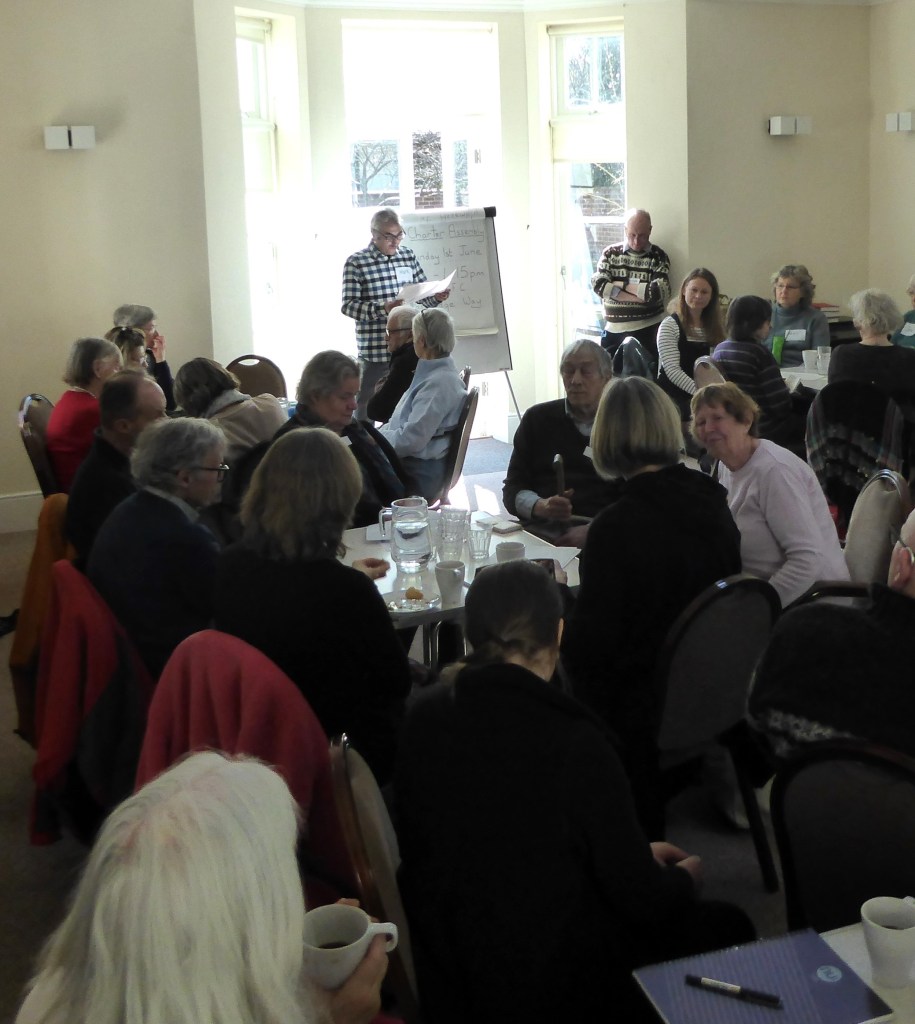
    The next meeting takes place on Sunday 13 April at St Gregory’s Hall (SP1 2SF, St Gregory’s Avenue off the Devizes Road) at 2pm. It is free to attend with a parting collection. The third is 1st June at the Football Club. You can come to either or both. To register your interest please leave a note here or contact mapotts53@gmail.com.

    Be part of a new force and make your views known.

    Peter Curbishley

  • Democracy Café: October 2021

    The Café was able to meet outside for a third time since lockdown

    Not only were we able to meet again but there were several new members and numbers attending were over 20 again. We discussed two topics from the eight that were voted for: ‘More houses for Salisbury – what are the facts?’ and ‘Global Britain – is it a force for good or a force for the bad?’

    We started with the housing question. Anyone driving around Salisbury, Amesbury and Wilton will have noticed the vast increase in the number of houses and huge new estates opening up where once there were green fields. Both ends of the A345 Amesbury Road have seen almost new townships opening up. The proposer noted that the 2006 – 26 allocation for South Wiltshire is around 10,400 houses and the current level of permissions is well over 11,000. In other words, WC has granted permission for more homes than the government requires it to. This extra building brings with it needs for more infrastructure, schools, roads and medical services in particular. Would it not be better to spend more money, not on new properties, but on refurbishing many sub-standard older properties?

    The issue of social housing quickly made its appearance. Although many new houses were being built, only a small proportion were affordable for those on low wages or for the young. Provision for those with disabilities was also poor. The point was made that the right to buy policy was skewed because the funds were returned to the Treasury and were not available to the local authority to construct new council houses (for rent). It was explained that the funds were originally Treasury funds so rightfully went back to them. The government could have changed the legislation if it wished however but chose not to do so.

    The debate broadened into the language we used. We talk in terms of ‘housing’ not ‘homes’, indeed, in the quote of the morning it was pointed out we only use the latter word in connection with second homes which aren’t homes at all. Should we not consider needs more? The system it was suggested should focus more on these needs rather than just responding to the market. This was part of the purpose of the planning system it was pointed out which is not popular and is being curtailed.

    Back to the issue of refurbishment and one of the problems is that new build does not attract VAT whereas refurbishment does. At 20% this is a serious disincentive. A change in the VAT rules would be of immediate benefit.

    One speaker thought part of the answer might be in increasing the level of council tax on second homes. There were 550,000 of these and around 300,000 on waiting lists suggesting he thought a ready solution. However, not all second homes were where the demand or the jobs were, some councils already charge a higher community charge for second home owners (one speaker knew this because her sister owned such a house in Wales and paid more) and would a higher charge induce someone to sell anyway? It was noted that not all second homes were for personal use but were rented out i.e. a home for someone.

    It was noted that some people are stuck in unsaleable flats because of the cladding scandal.

    Land was mentioned. It was noted that agricultural land might sell for around £5,000 and acre but with the benefit of planning, it could fetch a thousand times more. A key element of the price of a house therefore was the land it stood on. Yet there were no policies to tackle this currently and the last attempt – Betterment Levy – was abolished in 1970. A single owner can reap a huge windfall from a sale of land which adds considerably to the cost of a house (or should I say home).

    The role of finance and the mortgage industry discussed. Britain was fairly unusual in Europe and USA in having such large freehold tenure. The majority rented in countries like Germany. This meant a home became an investment not just a place to live. The result was a very large finance industry which it was argued, shifted power away from politicians and towards the financiers. The equity that people had in their homes also led to issues of inheritance and the expectation that it would pass unencumbered to their descendants.

    On the subject of new build, the fact that new houses were not being built to high enough insulation standards was thought to be shocking. Few of the estates had solar panels fitted as standard, an optimum time to do so when being built.

    In Salisbury itself, the development of several large developments for the retired was altering the balance of the city. There was an absence it was claimed of people in the 20 to 40 age band. They tended to leave and only return in middle age.

    If there was a theme to emerge it was that the market was not serving the people but was determined by the power and will of the developers. Their motivation was of course profit maximisation.

    After a break we tackled the second topic about the meaning of ‘global Britain’. What was our place in the world? Has it been coloured by by our colonial past? Do we as a nation spend too much time ‘in the past’?

    In Asia, the perception of Britain was of a ‘chocolate box museum’. In China, where memories are long, our role in the Opium War and colonial repression is still remembered. Talk of human rights do not readily impress. In Europe, their view of us is bafflement (following Brexit it is assumed). The special relationship with America is viewed as something of a joke. All sobering thoughts. It suggested we should show a bit more humility.

    Globalisation was not universal however. Capital was free to move sometimes at the press of a button, and goods are services could sold around the world with only limited restrictions. People were not free to move on the other hand which meant globalisation have different implications for different people.

    On the other hand, the English language was a huge asset and influence and contributed to our soft power. Our cultural influence was extremely strong as was our academic excellence and scientific prowess which is still admired around the world. We were still a relatively uncorrupt country. Perhaps we shouldn’t talk ourselves down too much: we still have some prestige for tolerance, liberty and human rights.

    Progress on this topic was difficult and we were left with the thought – was it little more than a slogan? Did global Britain actually have any meaning? Perhaps ‘Britain in the world’ might be better but it was less catchy.

    Two interesting if quite different debates and the next meeting is on 13 November at 29 Brown Street, our new home.

    Peter Curbishley