Tag: politics

  • Democracy Café: February

    February 2025

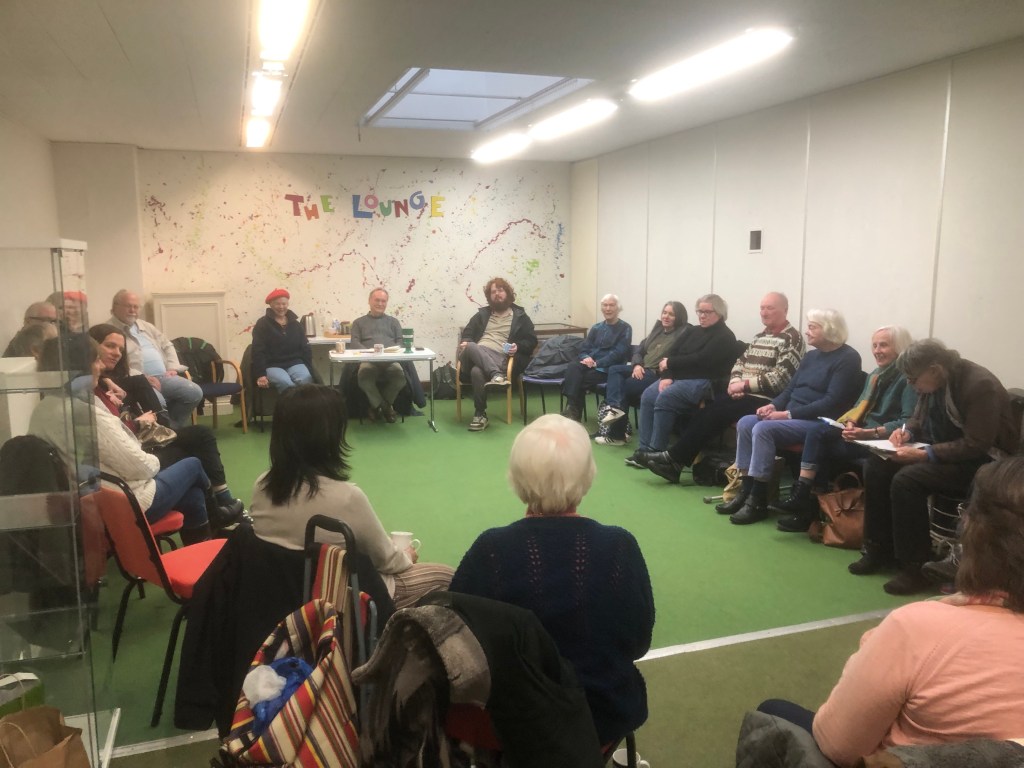
    Largest assembly for the Café since its formation

    The room in the Library was full for our café on 8th February and we discussed two quite unrelated topics. But first, it is timely to thank Salisbury Library for giving us this space. Libraries have had a tough time in recent years with one report saying 180 have closed since 2016. We much appreciate them for enabling us to meet there.

    There were a large number of topics suggested (around 16) and the one which won the most votes was How do we get growth, and do we want it? This of course arose following speeches by Rachel Reeves and Sir Keir Starmer who have nailed the Labour party’s flag to the growth mast as the solution to the country’s many ills. ‘To believe in growth on a planet with finite resources is either a madman or an economist’ thus spake David Attenborough. The third runway idea seemed to ignore environmental issues which appeared at one time to be an important element of Labour’s policy. But how to change the narrative was the question. The assumption that growth was the answer to problems is almost assumed wisdom without it ever being questioned.

    The idea of a third runway at Heathrow was unlikely to be successful it was thought: interestingly, the reasons didn’t need to be spelled out. Kate Raworth’s book Doughnut Economics was mentioned which included a critique on the very topic we are discussing.

    Tax should be reframed as a social good

    Tax (as ever) was mentioned and the observation that people want services but the moment raising taxes to pay for them is mentioned it was political death. There was no sense of pride in paying tax as a contribution to the public realm. Tax was always presented negatively as a cost not a contribution. It should be reframed as a social good (this was the first time a remark was applauded in the history of the Café!). The results of not doing things (as in not spending on schools, hospitals etc I think was meant) never seemed to be discussed. ‘Living Danishley’ was mentioned – an economy with higher taxes but also higher welfare where there did seem to be higher levels of contentment. One hopes the people of Greenland agree.

    It was pointed out that there were two aspects to growth: the short term focusing on GDP and the longer term which was concerned with matters such as productivity, improvements in which have defeated politicians for decades. We must not lose sight we were reminded of some of the benefits of growth, the reduction in poverty for example

    A fundamental point which seems to escape most politicians, is what matters is that those with assets already tend to gain the most whilst those without assets tend to lose out. Almost Biblical in fact: “for he that hath, to him shall be given: and he that hath not, from him shall be taken even that which he hath.” Which seems apposite in Trumpworld. It was about the distribution of wealth. It was noted that just 62 people own half the world’s wealth. Since much of this wealth was in a tax haven somewhere, it was ‘dead money’. One of the consequences of not investing was the huge rise in child poverty. Estimates vary depending on definitions and whether relative or absolute poverty was meant, but what was clear was a huge rise in the numbers. It was not all right for many with poverty and poor housing common.
    The point was made that GDP (Gross Domestic Product in case you weren’t paying attention in your economics class) didn’t measure everything. In fact it measures income and there are many aspects which make life worth living which are not measured. The Happiness Index being used in Bhutan was an interesting observation (and the link is well worth a look if this is new to you). Another point is that changes in GDP were incremental and often very small amounts of a percentage or fractions of a percent. Distribution (of wealth) was much more significant.

    The book The Spirit Level was mentioned and one of its key findings that inequality hurts all people not just those at the bottom of the heap so to speak. It was noted that the welfare state introduced after the war had been ‘bypassed’ as it was expressed and politicians today don’t promote social responsibility. This was linked to the tax point above. The state was increasingly relying on charities to step in and do the things the state used to do.

    ‘Getting rich’ was the only philosophy

    No Democracy Café is complete without mention of the media. It was suggested that one problem was the media’s desire to glamorise rich people so that wealth was regarded as a good thing in itself. Do we trust social media? ‘No’ was the answer (unfortunately, many do). However, it was pointed out that not all social media was the same and it did allow for a diversity of views. It devoted too much time to discredit reliable sources someone said. The failure by the government to enunciate a coherent philosophy didn’t help it was suggested leaving the idea that to get rich was the (only) way forward. Bad news makes the headlines someone observed. Large elements of our media were owned by foreign oligarchs who were able to control the narrative.

    Overall, a general conclusion that growth by itself was of little value unless more was done to ensure it was distributed more fairly. Ignoring the environment to achieve it didn’t find favour either.

    The second topic was What are the burning issues facing Salisbury and what are the solutions? Transport was quick out of the blocks followed by the numbers of empty shops. A big rise in foodbank use was mentioned and flooding.

    On transport, the related issue of congestion was brought up. Charging people to enter the town centre was suggested. A suggestion to one of the Area Boards a few years ago that the City centre be pedestrianised was not met with enthusiasm to put it mildly. There was a strong car lobby in the City. Attempts to make Salisbury more people friendly didn’t always get far. The Cycling Opportunities Group for Salisbury (COGS) had suggested safe cycle routes for example which did not fully succeed.

    Building houses on the flood plain was mentioned by several and was unsurprisingly, not seen as a good idea. As water levels rise … well you get the idea. At this point it was noted that several of the suggestions were beyond the powers of the City Council to do anything about. It was after all – absurdly – a parish council with very limited powers. It was also limited to the City boundary and did not include adjacent villages or places like Wilton. The Council may well object to housing on the flood plain but housebuilders had huge resources to be able to defy the council and the minister would overrule any objections [that very day, the Guardian reported ministers’ intentions to build thousands of houses on such areas]. Halt Harnham Housebuilding was mentioned. The drivers for change were not local.

    On the topic of housing two matters were mentioned. Many older people lived in large properties and might like to downsize. It was not easy however and the costs of some supported housing were high and uncertain. Second homes were criticised although Salisbury is not such a centre for this. Some places in Cornwall and Wales were plagued by them.

    What the vision was for Salisbury was questioned. What will the City look like (at some future time)?

    What was there to keep young people in Salisbury? What reasons were there for them to stay here? Things like the LGBQ café had closed down for example. Someone asked ‘why should I come to Salisbury?’ With closed shops and an increase in cafés and hairdressers, it lacked excitement they thought. It was observed that in some Baltic states, multiple shop owners had to relocate on the periphery and only small retailers allowed in the centre. However, someone said that the most common question they get asked is ‘where is Marks and Spencers?’

    It was suggested that part of the problem was that Trowbridge felt remote. The Plain was a definite barrier with poor communications. There was an argument for the county to be split into two, north and south (forgive me for adding a link to a piece on this subject).

    The role of private contracts with the local hospital was mentioned. This was a concern and ‘backdoor’ privatisation of the NHS was a worry generally. Trying to find out the true story here is not easy with company take overs and such like. Twenty20 Capital is an ex Virgin organisation and we must be worried that a venture capital entity is taking over the local hospital. Will it follow the usual practice of these companies to strip the place bare and ‘do a water industry’?

    There was some discussion on the College which now apparently did little in the way of further education. It was a result someone said of ‘Ofstedisation’ that is learning which was all about outcomes and outputs. Several issues discussed and we were reminded of the forthcoming People’s Assemblies in Salisbury that attendees might be interested in.

    Peter Curbishley


    Items mentioned:

    Simon Schama: History of Us BBC iPlayer

    The Spirit Level, Richard Wilkinson and Kate Pickett, 2009, Allen Lane

    Doughnut Economics, Kate Raworth, Penguin

  • Annual meeting

    January 2024

    We held our annual meeting on 28 January at the Boston Tea Party and the following matters were discussed:

    – The existing officers of SDA keep their positions. Marks Potts as chair; Andrew Hemmings as Treasurer and Peter Curbishley, publicity and the website.

    – We discussed the Democracy Café which continues to meet and it has been a success. There was a suggestion for a change in format. After discussion it was agreed we would vote for the following months topic at the end of the previous session so that people knew something about what was to be discussed. We would do this once as an experiment. This was a change in the original concept and there might be a problem of people arriving with too much material. One problem is the time between cafés which meant fresh topics would be too late. We will see.

    – We agreed on a presence at People in the Park in May. There was a discussion on doing a role play exercise based on our presence there but it would be too difficult to organise.

    – There was a discussion based on Phil Tinline’s Democracy programme on the BBC. Could we do a similar exercise here in Salisbury? We will explore to see in he could come and give us a talk on the subject as his parents live in Salisbury. Perhaps in the Autumn.

    – We have funds of £212.

    The rest of the meeting was taken up with a discussion of Assemble and there is more on this topic on our next post.


    The next Democracy Café takes place on February 8th starting at 10:00 in the Central Library. If you would like to join us you would be very welcome.

  • Democracy Café

    December 2024

    The question ‘Why don’t socially progressive politics get more traction in the UK?’ with an added thought that could the UK turn into a fascist state? won the vote today. In explaining the topic it was asked why people and the planet don’t matter more than profit? Isn’t what matters is the whole of society not just a select few? Wealth concentration seems just to benefit a minority. The notion of ‘trickle down’ has not worked: inequality has increased year by year.

    One reason is that the wealthy have the ear of government. They are able to stir up fears of progressive policies. Remember the fuss around minimum pay? There was a dangerous combination of power and vested interests. An example might be farmers who have protested a lot recently concerning government plans to widen the scope of the capital gains tax. They own 40% of the land yet contribute only 0.6% to the national income.

    Labour won a big majority in the recent general election yet how progressive are they in fact? The plain fact is that the Tories keep winning and have been in existence for 2 centuries. Labour had to water down their policies to enable them to win it was claimed. They had ‘caged themselves in’ it was said. Politicians played to the media. It was politicians who dominated the airwaves. Rory Stewart’s book was mentioned and his unsuccessful attempts to improve policy making.

    Was it another example of media power. A handful of wealthy owned much of the print and online outlets and sites. Oligarchs were not known to be fans of progressive policies and their publications echoed that. It was claimed that the civil service were ‘not keeping up with the times’ and that ministers could not rely on the successful implementation of policies. A remark very similar to those made by the Prime Minister recently in his ‘managed decline’ speech. However, it was easy to blame the service someone said but were we clear about its value?

    An anomaly was the court system which was clearly falling apart. People are waiting years for justice and cases are abandoned because of the lapse of time. The courts are there to protect the establishment yet they are failing. The judges are a powerful component of the elite yet they have not been able to improve matters.

    Was tax an issue? People clearly want the NHS to be fixed, to get dental care and the potholes to be filled in but they do not want to pay higher taxes. Any politician saying ‘I will do these things but I’m going to put 2p on your income tax’ is unlikely to get voted in. The problem was that people who were already poor would resent paying more. The question was how to tackle the wealth issue and the idea of a maximum income. An aspect of this topic was that the wealthy do not use buses for example and therefore have little interest in their provision or efficiency. (Mrs Thatcher famously never used a bus). Cutting public spending was popular and the president of Argentina Javier Milei was quoted as being an enthusiastic cutter of public spending. (Argentina does have massive economic problems and one of the highest inflation rates in the world. Strange to think as an aside that the country was once tipped to become one of the wealthiest in the world. The name derives from the Spanish word for silver which was found in abundance by the colonists). Back to the plot …

    The message of the rich is always in the ascendant’

    We talk of ‘trickle down’ it was noted but what about ‘trickle up’? It was about the distribution of wealth. Currently, considerable wealth was in very few hands and much of it was invested or went overseas rather than spent. If wealth was better distributed then more of it would be spent thus increasing the size of the economy. Perhaps, sardonically, it was noted that ‘trickle down’ obeys the law of gravity whereas ‘trickle up’ requires a revolution. Well, maybe not so sardonic. The message of the rich is always in ascendant. The same speaker spoke favourably of Marxism.

    The tax point was taken up and the fact that economics was not taught in schools – a point discussed at previous meetings. We needed a more literate society in these matters. There was a need for both economics and politics to be taught. The problem with the latter is that politicians were fearful of ‘lefty’ teachers indoctrinating children – a ghastly thought.

    Scandinavia was mentioned as a society which was more egalitarian and where there was high levels of tax to pay for welfare. Finland was the country with the happiest citizens.

    We got onto neoliberalism and the history of the project. It started in the University of Chicago with the ‘Chicago Boys’ and their first ‘experiment’ was Chile where a revolution was instigated by the CIA to oust President Allende and install President Pinochet. It was all about a small state, low taxes and free market ideas. The UK was next under Mrs Thatcher and it spread thence to the USA. The UK was little more than a vassal state to the US it was claimed yet it was something which seldom appeared in the media.

    There was a brief diversion discussing Syria (Assad had been deposed this week and it was the main feature of news programmes).

    Finally, the protests in Westminster by farmers protesting about CGT. It was noted that despite blocking chunks of the capital with tractors and disrupting traffic, no one was arrested. Contrast with climate protestors some of whom are in prison. Yet no outrage in the media about the disruption. Odd that. Who’s interests are being protected someone asked?

    A concluding remark was to say that complex problems are reduced to binary issues. Then to demonise one part (immigrants for example or the ‘workshy’). We were left with the original question – where is the compelling narrative from progressive politics? This perhaps was a clue to the problem. Society is complex and the problems are complex also. Solutions had to be nuanced and were unlikely to be simple let alone able to fit the binary narrative. This made ‘selling’ them to the electorate challenging.

    The second half debate was on prisons and the question was ‘Why do we go on locking up more and more people and for longer?’ Prisons, and prison overcrowding, are much in the news presently and the new government was forced to release many prisoners early to find space. Is sending people to prison a deterrent? Someone who visits prisons said research has shown that it doesn’t work. By this we meant that the recidivism rate was extremely high. Many came out with crime skills enhanced rather than reduced by better behaviour.

    Politicians like Ken Clark and Rory Stewart were mentioned along with David Gauke and Lord Timpson all of whom in different ways have realised that the system is ‘broken’ and we cannot go on simply stuffing more and more people into already overcrowded gaols. Attempts to reform the system have quickly failed because of various prime minister’s fears of public reactions. This was summarised by the phrase ‘tough on crime’ and all politicians are nervous that any reform will dent their reputation for toughness. The public are fearful someone said (of criminals I assume they meant) and this was driving a lot of media hostility.

    There were good ideas and Lord Timspon, the Minister of State for prisons, was a hopeful appointment. His firm appointed many ex-offenders in their shops we were reminded.

    The current 2024 Reith lectures were mentioned as they discussed aspects of this problem and in particular the issue of evil. It was argued that therapy could change people. People have to want to see changes it was said (quoting Lord Timpson). Some US states – including some Republican ones – were adopting these principles. If the prevailing view however, was ‘lock ’em up’ then change was unlikely: actually, not ‘unlikely’, it won’t happen. If you dehumanise people in prisons (and many were infested and there were two prisoners in each cell in many cases), it was no surprise they came out worse.

    We were fortunate to hear from someone who works with sex offenders coming out of prison. Most had made up their minds not to reoffend. Their work was to help them stay away from reoffending by offering them help and support. They would like some of the experiences fed back to influence policy. It was noted (and almost passed unnoticed) that this work was being done by volunteers. The inference being (I am suggesting) that this should be an organised programme of activity, not something that depends on a small charity which has to scramble for funds to survive. We were reminded that many in prison had emotional problems, were abused as children and literacy rates were low.

    Perhaps we should try the Socratic method it was suggested. Ask the prisoners: is it doing you any good?

    The discussion moved to causes. In a sense, imprisoning people is the end of the line of society breakdown. If inequality is rising and people are living in poverty there is a tendency to criminalise social conditions. We need to explore the underlying causes not endlessly talk about symptoms. If you reduced the ‘input stream’ as it was expressed, you reduced the ‘outputs’ of criminality.

    There was a problem however. The discussion was focused on rational argument. The assumption being that by establishing facts and finding out what worked, policy could be changed for the better. As already noted, some ministers have tried this and come unstuck, as in sacked. Prison policy was fixed on emotional reactions and, as someone said, vengeance.

    It was noted that when John Glen first became MP, he was asked about voting for prisoners in their final year or two of their sentence, say. He did not agree with this. David Cameron, the then Prime Minister, said ‘it made him sick’. It was subject to a long-standing row with the EU.

    Finally, religion made its entrance and Old Testament beliefs. There was the doctrine of original sin although this was a late addition to the Christian faith. The Quakers were in the forefront of prison reform and the Methodists were active in the anti-slavery movement.

    These were two good debates and it was interesting that a key element in both was the issue of how the media treated the various topics. Whether it was around how society is run or the reform of the prison system, if people are bombarded by negative attitudes, if argument is reduced to simplistic notions and the owners of newspapers and social media sites can exert such power, change will be difficult to achieve.

    [Added 6 January 2025] On the question of tax, the following link was suggested https://www.taxresearch.org.uk/Blog/

    Peter Curbishley

    Next meeting on Saturday 11th January 2025. Seasons greetings to all our readers!


    Latest posts:

  • Assisted dying

    The Bill raises troubling aspects about our democracy

    November 2024

    On Friday 29th November, the House of Commons will debate the private members bill to allow assisted dying. Views about this are very varied. Some, who may have experienced a loved one suffer at the end of their life, may be in favour. Others, and sometimes for religious reasons, are opposed to it. Still others worry that it will be abused and that it is the ‘thin end of the wedge’. Elderly people are known to worry about ‘being a burden’ and might consent to the procedure for quite the wrong reasons. There may be the occasional family keen to hasten the end of a parent with the aim of securing their inheritance sooner. Medical staff, committed to saving life, may be reluctant to be drawn into doing the exact opposite.

    There are matters both of conscience and practicalities. The latter to ensure that there are watertight procedures to prevent abuse of any kind. Recent medical scandals have shown however, that the profession cannot be relied upon to police itself reliably. Medical people who whistle blow are treated shabbily by the NHS and often driven out of the profession altogether. Our judicial system is less than perfect with miscarriages of justice galore. You only have to say the words ‘Post Office’ to see into a world of corruption, incompetence and the mass failure of our various institutions to do the basic business of acting with honesty and integrity. Dare one mention Archbishop Welby exposing yet another institution failing spectacularly. All around, whether it’s government, police, the judiciary, NHS, Anglican and Catholic churches, there are examples of gross failure to protect the vulnerable, to act honestly, to be open or admit failure.

    Given these facts, it is not too surprising that there are some who are reluctant to put themselves into the trust of such flawed institutions.

    However, accepting that there are many – and by some polls, a majority – who would like this to be law, the question is how, as ordinary citizens do we make our views known? In Salisbury, our two MPs are John Glen and Danny Kruger. The latter was exposed in the Observer for allegedly being a kind of ‘front’ for evangelical Christians who have contributed £55,000 to the campaign against the bill. He is being investigated by the Commons Standards body and we must await their findings. We do not know what Glen’s views are but he is also an evangelical Christian and often mentions his faith as a guiding force in his life.

    Is our democracy working?

    This raises interesting questions about our democracy and how it works in our corner of the world. Both these are likely to vote against the bill (Kruger definitely, Glen probably) on the basis of their religious beliefs. Yet, the recent census shows that the number of people who are Christian is now a minority at 46%. It has declined significantly from the previous census. Those who actually take an active part in the religion is much smaller still.

    Do either of them know what their constituents think about this? I very much doubt it. Although some MPs have honourably and assiduously gone around their constituencies and attended various meetings to find out, I am not aware of either of ours having done this. Parenthetically, if it passes its second reading it will go to the Lords where a collection of bishops will have their say: the same bishops who are part of the deeply flawed CofE. There is at last a move to have the bishops removed from the Lords. [It did pass its second reading. Both Kruger and Glen voted against the bill]

    So the MPs, in all probability, will vote against the bill based on their personal and religious beliefs. In a personal capacity – the same as anyone else – they are free to express their views for religious or any other reason. But they are supposed to represent the constituency and not just the religious people within it.

    Citizens’ Assembly

    These arguments suggest that we should have had a Citizens’ Assembly on this matter. That would have enabled an informed debate to take place and for a wide section of the community to take part. The failure to do so, and an almost complete failure in the media and elsewhere to suggest that such a thing should take place, points to a breakdown in our political process. Not only do our MPs not know what their constituents think about this important issue, but many in Kruger’s constituency will be unaware he is being investigated over the matter. Neither the Salisbury Journal nor the Gazette and Herald have reported it. [Correction: 29 November. both G&H and SJ have now reported it on line.] Glen reveals that the majority view of his constituents was for the bill which passed its second reading today.

    This is an important moment and the Assisted Dying bill is the latest example of people being given the power to decide their own fates and it not being determined by church or state. If the bill falls, it will be a long time before it is put forward again. As citizens of south and east Wiltshire, we are surely entitled to have our views known and taken account of. Instead, we have one MP acting surreptitiously, it is alleged, on behalf of a religious group and another driven by his evangelical beliefs. To what extent are they reflecting the views of those they are paid to represent? The answer I suggest, is not at all.

    Peter Curbishley

  • Democracy Café

    November 2024

    Post amended 23 November

    A lively and well attended session on the Saturday following the wonderful/disastrous (please delete as appropriate) election of Donald Trump to be the next president of the USA. You may not be surprised to know that eight of the 10 topics people proposed were, in some way or another, connected to this event. The one actually chosen was Why did the Democrats lose the election?

    It was suggested that many – a bit like the UK election – didn’t like either candidate, so ‘held their noses’ and voted for Trump partly because he fitted their views. It was suggested that Donald Trump focused on the economy (mostly) whereas Kamala Harris by contrast spent time on things like women’s issues and seldom discussed the economy. It was noted that in fact the economy was doing quite well with 2.2% growth and inflation at 3% but the Democrats failed to get the message across.

    The elephant in the room someone said was the middle east and Gaza in particular. Democrats were put off by Harris’s attitude and silence and many Moslem’s did not vote.

    Another factor it was noted was the late entry by Harris and the lack of a primary. She had little time to establish herself. She was a poor candidate someone thought. Would there have been a different result if the Democrats had had a better candidate it was suggested? I was asked, after the meeting, to include this link to a Guardian article from someone who worked for the Democrat team over the pond. It is an interesting perspective.

    A different view concerned people’s lack of understanding of economics. The discussion moved to the UK at this point and it was noted that it is not taught in schools below A level. It is seen as a specialist subject and is a small part of the curriculum even where it is taught. Bill Clinton’s ‘it’s the economy stupid’ was quoted to express how important the subject was to people. In this connection, it was said that whereas the economy might be performing well but for many Americans, life was a struggle. Someone who’s son was in Texas said they don’t feel well off.

    Back to the USA and the Democrats had a credibility problem it was said. Her focus on gender identity issues; women’s rights combined with Jo Biden’s very visible decline contributed to their loss of credibility. Someone did ask: ‘did Harris achieved anything?’ (as VP) which was left unanswered. But then it was noted that vice presidents seldom did achieve much – it was the nature of the post. We were reminded that if Trump should be unable to carry on as president for some reason, JD Vance will assume power … We swiftly moved on.

    At this point it was noted that the word ‘populist’ has not been used. It was a pity we didn’t discuss this further.

    A different perspective emerged when someone reported on some comments made by Bony Greer on the last edition of BBC’s Question Time. She is reported to have said the US was a completely different country sitting as it was between two oceans. It was populated almost entirely by immigrants yet most saw themselves as ‘post immigrants’. Immigration was a hot topic in the election and a weakness for the Democrats. Rather like the boat people in the UK, immigrants coming across the border from Mexico were not popular. Trump had tuned into these feelings. It was noted that home produced goods will be more expensive than imports and how will Americans cope with that? Wages were not keeping pace with inflation.

    America had prospered after the war and had many manufacturers of cars, domestic goods, clothes and much else. Many of these jobs had gone overseas and had left vast swathes of middle America with few jobs. Detroit was an example. Although the country might be prosperous, large areas weren’t and there was much poverty. As someone noted ‘it was easy to be a liberal when you’re better off’.

    It was easy to be a liberal if you are better off

    It seemed to suggest America was becoming more isolationist. The proposal to impose tariffs on import with China likely to attract 60% was perhaps evidence of this. On the other hand it was noted that America has a history of involvement around the world. It had intervened in many South American countries fomenting coups and other activities.

    In the second half we felt sufficient time had been given to the American election and decided on the topic of the Intimidation of media in the UK. The proposer mentioned the Electronic Intifada site and the arrest on terrorist charges of one of its journalists. Craig Murray was also mentioned who was sacked from his diplomatic post after exposing human rights abuses by the Karimov regime. The contention was that journalists were being arrested for carrying out honest journalism. [Amendment 23 November. It was clear that few had heard of the arrest mentioned at the start of this paragraph which in a way, reinforces the point that it is not just mis and disinformation but the denial of information by the media. In December’s Byline Times, Peter Oborne has written a short piece which is relevant and of interest].

    SLAPPs were mentioned as another pressure to limit press freedom. [There is no single definition of what is a SLAPP – Strategic Litigation Against Public Participation – but they consist of a range of legal measures to make exposing wrongdoing extremely expensive and act to prevent publication of such wrongdoings because the costs are too great. It is generally agreed that SLAPPs act against the public interest and free speech]. It was noted that London is regarded as the ‘libel capital of the world’ and venue of choice for those wishing to silence criticism.

    We were urged to read publications such as Declassified UK which publishes stories the mainstream media is reluctant to. There was also the D Notice system and that we are not allowed to know that such a notice is in existence. The current conflict in the Middle East was mentioned and how journalists were muzzled, although it has to be noted that they are not allowed into Gaza. In this context, Haaretz was mentioned, which despite being based in Israel itself, was a surprising source of information which does not see the light of day in British media.

    The debate hovered around independent views in the context of the media and someone wondered if there was much demand for this? In the context of the US it was suggested that, to quote, ‘they couldn’t give a monkey’s’ (for independent views). People read material which reflected their opinions. Byline Times was mentioned (and recommended) by a few as providing some kind of spotlight on media activity. Others suggested Tortoise Media and Middle East Eye. This suggested the importance of critical thinking – a topic we have discussed in previous DCs – and the ability to analyse critically what we are being told. The distinction (in the media) between fact and opinion was important it was stressed and indeed, some media did make this distinction clear.

    An ex Open University tutor stressed the importance language and the meaning in words. Students were encouraged to carefully appraise what they were reading to establish its reliability. We were invited to look up Harry Frankfurt, the author of several books on the subject of ‘bullshit’ which he has carefully analysed (these Americans, whatever will they think of next?). You may wish to follow this link which is a sea of text I’m afraid but nevertheless, does give you a good insight into this topic.

    Facts someone said, were all very well, but they did depend on your perceptions. I think the point being made here was that fact was difficult to discern and it did depend on the recipient’s interpretation of them hence, could anything be a fact? What a pity Wittgenstein could not come to our discussions and help us out. That, come to think of it, is a fact. Someone noted the idea of ‘evidence based medicine’.

    Back to the original topic and problems of free speech. The Southport riots saw many people arrested and imprisoned as a result of the violence. The problem was free speech and the distinction between ‘inciting’ and ‘challenging’. Who decides? The first amendment in the US guaranteed free speech (an issue which may be tested if Donald Trump’s threats are to be believed) which we do not have in the UK. It was noted that ‘one person’s rioter is another person’s freedom fighter’ (Gerald Seymour, 1976). There was a link between ‘fact’ and ‘values’ a comment which seemed to echo the issue of perception.

    No platforming a slippery slope towards totalitarianism

    Concern was expressed about the notion of ‘hate speech’. It led to things like no platforming in universities where those who’s views are deemed unacceptable are not allowed to speak. This was a slippery road that led to totalitarianism it was suggested.

    The internet and the world wide web were seen as hugely beneficial when they first appeared around three decades ago. They have a huge influence over our lives but no one voted for them. We are now on the verge of an AI revolution but again, no one has voted for it.

    Comment

    Two really interesting debates and although we have oft debated the media in these meetings, we somehow broke new ground this time. Perhaps the war in the Middle East and Gaza has exposed the weaknesses of the mainstream channels. The alternative sources mentioned above together with al Jazeera and – somewhat surprisingly, Haaretz – provide more insight into the terrible events taking place there. The threat side of things is something we have not touched on before and it will be interesting to see if some of the restrictive legislation passed by the last government will be repealed by the new. Perhaps it would be inadvisable to hold one’s breath.

    Peter Curbishley

    Next meeting on 14th December at 10:00 in the Salisbury Library. People seemed to like the table less format so we will repeat that. It’s only the scribe who loses out …

  • Democracy Café – October

    The debate covered what was worth knowing and arms sales to Israel

    October 2024

    Full house for the October meeting with two lively debates.  We were also pleased to welcome several new members.  The first debate which won the vote was What is worth knowing? which quickly changed into a debate about what was taught in schools.  The first suggestion was ‘all that they need to know after they leave school’.  Another thought knowing the names of things important especially as it related to the natural world. This was followed by the suggestion that children should be taught the (true) history of the monarchy and what scoundrels and ‘thugs’ many were.

    A deeper question centred around knowledge or wisdom.  This point was made by several in the course of the debate and concerned the distinction between facts and the capacity to think critically about them. 

    In a similar vein, the importance of relationships was stressed.  Indeed, there was a torrent of suggestions which included the importance of an appreciation of the arts and music; to develop a passion for something in young people; to teach young people to trust their own instincts; teaching how to look for information and the need to teach practical skills especially as so much was spent at the keyboard.

    Critical thinking was mentioned more than once.  It was felt by several that facts alone were not sufficient but there was a need to foster enquiry and scepticism.  In Dicken’s Hard Times, currently being serialised on Radio 4, the main character’s insistence on facts and only facts, that’s what’s wanted – should not be the sole the focus of education.  Was education just about learning stuff to get a job (which sometimes seems to be a government view)?  This brought us to the national curriculum which was seen as something of a straitjacket.  This arose in a discussion about citizenship which some thought had disappeared because of time pressures and the need to get through the national curriculum and pass exams.  It turned out from a quick google search that it’s still around but it is very narrow and focuses on local government and similar parochial matters. 

    One speaker said how disturbed they were to see in a school a chart on a wall with a grading of children on it.

    Faith schools were introduced into the debate.  There are many in the country and a sizeable number were unregulated.  Creationism was still being taught in a few for example. One said ‘faith in schools’ was important rather than faith schools per se.  Spiritual awareness was important.  On the other hand, we now live in a secular society, faith should be a family thing.  The morning assembly was mentioned – a requirement of the 1944 act – but has now been replaced by what is termed an ‘act of collective worship’.  One person said that it used to be the case that non CofE pupils (Jews for example) were excluded from morning assembly.  It seemed to be agreed that teaching pupils about religion was important in view of its significance in our history and culture.  You needed to know about it to evaluate it one said. 

    We were reminded of a pertinent fact namely: children are naturally curious.  Why is it that this seems to get lost?  We did not debate this but the tenor of our discussion was about didactics and what should be learnt.  Yet the system seemed one way or another to dampen this natural curiosity found in children. 

    The mania for exams and qualifications was mentioned in connection with the College. It ran a course called ‘philosophy of our time’.  However, when the government introduced the lifelong learning initiative, perversely it required a qualification at the end and the tutor decided to run it privately. 

    Of course arguments about what should be taught in schools are as old as the hills.  How we acquire knowledge is changing rapidly, one said that their previous role as a librarian has all but disappeared.  What children need for life is also changing rapidly.  There seemed to be a consensus around the problem of government-imposed restrictions.  This meant that time given to ‘life skills’ (however defined) was limited.  There was a real need to facilitate critical thinking and a questioning attitude. 

    The second session after a break, tackled the vexed question How do we stop selling arms to Israel?  The question inevitably morphed into should we still be selling arms? There were several interventions concerning the history of the area.  Historically, British and French interests focused on the Suez Canal’s importance. It was a crucial link to India. At the beginning of the last century, oil also became significant. They did not want Arab run states on both banks of the canal.  The UK’s role in setting up the state in 1948 and the violence which followed was mentioned.  Balfour also got a mention and by implication the Sykes – Picot Agreement which divided up spheres of interest in the region after the collapse of the Ottoman empire.

    It was noted that, however much we might disapprove of the weapons sales and the use to which they are put, Israel thinks it is fighting and existential war.  Hamas and Hezbollah – as proxies for Iran – are devoted to the destruction of the country and to drive all Jews into the sea.

    While some may have agreed with this, the worry was the disproportionate nature of the destruction.  The seemingly wanton destruction of entire blocks of flats allegedly because it contained a terrorist. The ‘human shield‘ justification was often quoted but seldom evidenced.

    A problem was the hard right and hawkish elements in Israel who were influential it was said.  Although diplomacy was mentioned several times, the present Israeli government is not in any mood to engage in it.  Aggression was ever present with a ‘you kill one of ours and we will kill a hundred of yours’ philosophy.  Both sides have to want peace for a solution eventually to be found.  Israel had to establish relationships with those in the region and – a point made more than once – they were all the same people and shared the same DNA.  Indeed, it was noted that historically in the Middle East, all sorts of communities: Christian, Jewish, Moslem and others lived and traded together in city after city.  It was not true to say there has been a perpetual state of animosity. 

    The role of the Jewish lobby in the US was discussed.  They are influential and powerful and able to get Senators and academics sacked it was claimed.  It was noted that the US supplies the bulk of military materiel: around two thirds of Israel’s needs.  What the UK supplies is small by comparison although we do make parts of the F35 which are not included in the embargo.  When questioned about this the Foreign Secretary, David Lammy, said ‘it was part of a global contract’.  Make of that what you will.  It was also noted that an Israeli arms firm Elbit Systems has a plant in the UK near Bristol.  It is not just arms we supply but it was claimed the UK provides aircraft based in Cyprus to overfly Gaza for intelligence purposes.

    What will be the situation if Trump wins the presidential election next month someone asked?  It was Trump, when president, who ended the deal with Iran.

    It was suggested that a root issue is trauma and Thomas Hübl was mentioned.  The trauma was not just about the holocaust it was claimed. 

    We were reminded that this issue of arms supplies to Israel is not a new one.  Both Mrs Thatcher and Edward Heath imposed sanctions on the country in the past.  In fact, this link shows that six prime ministers have imposed sanctions and hence Labour’s decision is one of a long line of such decisions.

    Another point concerned war crimes and the International Court of Justice. If it is decided against Israel, then the UK will be obliged to end arms sales. 

    We were chided for not answering the question put namely how do we stop the arms sales?  Perhaps another day …

    Peter Curbishley

    In an article by Kenan Malik in the Observer (13 October) he reminds us that Netanyahu supported Hamas as a means to divide the PLO and prevent a Palestinian state.

    [amendment made 13/10: F15 should have been F35]

  • Democracy Café

    October 2024

    Don’t forget it’s the Café today, Saturday 12th in the Library starting at 10:00 for 2 hours. All are welcome. Browse this site for examples of previous debates. You can suggest your own topic or vote for someone else’s.

  • Democracy Café: September

    The power of the media: influence and control

    The group (17 strong this week) met on September 14th as usual in the Library with 2 topics chosen by vote for discussion.

    The first of these was  ”Should the power of the media be in the hands of the people who currently control it?” The media has been a fairly constant topic in our discussions, both national and local.

    Much of the debate centred around trying to understand how influenced people are by the media, both the press and social media. The newspaper market is small and elderly, but dominates politics. It was suggested that papers used to be driven by their readers, but that now the owners choose what is important, and this can be dangerous. Defined as “framing”, this means the reader receiving a partial view, which can be resistant to persuasion. (It was said that positive ideas need 5 times more effort than negative to have an effect).

    Politicians are afraid of the media, but, as one member said, they should “grow a backbone.”

    It was also pointed out that a factor in news reporting is the prevalence of SLAPPS (Strategic Lawsuits Against Public Participation), by which the judiciary can interfere with the publishing of unwelcome information about a person or organization, simply because of the cost of pursuing a case, if charged with defamation. The practice of wealthy litigants paying a sum into court means plaintiffs run the risk of having to pay both sides costs – which runs into millions – if they loose. The Murdochs have paid over £1bn to keep phone hacking out of the news using methods such as this. It’s called ‘British justice’.

    But those under 40 don’t tend to read papers. Social media gives access to your preferences and this leads to confirmation bias. For many, social media is where they are getting nearly all their news. A possible remedy would be to make the algorithms available to the public. (There may also be a need for opportunities to be created to re-educate older people about social media)

    Another suggestion was that The Guardian model of the newspaper being owned by a Trust could be a better option than ownership? Someone else observed that podcasts are a better source of information.

    Likewise with social media sites – open source sites such as Bluesky or Signal don’t use the algorithms that X or TikTok do.

    The recent riots have been a useful indicator of the issues. Certain parts of the Press could be accused of adding fuel to the fire, while ostensibly standing aside. The people on the streets were prosecuted, but not those who incited them. The Government’s subsequent prosecutions did not include some who were implicated in the background.

    In conclusion, we were left wondering “why do people believe what they believe?” Whether we are nearer an answer remains to be seen.

    The second discussion concerned whether the Government should stop selling arms to Israel. Some attendees felt (quite strongly) that there was no justification at all for selling arms, believing that claims of genocide were true. Others were concerned about the possible loss of influence it would involve.

    Questions were asked about the extent of British involvement – we are low on the list of suppliers, but arms sales generally are big business (8-10% of our exports), and it is important in our area, even if more through agencies than actual manufacture. The Foreign Office has an open licence policy, but the new government has withdrawn 30 licences out of about 350 over concerns about international humanitarian law.

    Concern was expressed about proportionality. It was pointed out that Israel’s targeting ability was greater than events would suggest which may have a bearing on what we should sell. They are a powerful military, the most powerful in the region.

    The comparison with our sales to Ukraine was made. The racial angle of the distinction was noted.

    International bodies have agreed that the regime is one of apartheid. This seems to be part of a change in attitude over the course of the war. It was questioned whether younger people who don’t get news from the newspapers (see above; the difficulty of journalists getting to the war zones was also noted) might have a different understanding of the situation. Generally the fear was that (partly due to the change in attitude in the US to its historic policing role) a sense of paralysis has set in. The situation was described as the economic colonization of Israel by the US and the political colonization of the US by Israel.

    A view was expressed that Israel may have no wish to agree a peace deal since off the coast of Gaza is a vast oil and gas field. Were a Palestinian state to have access to this resource, it would alter the politics of the region immensely.

    Clearly not an issue that is going to be resolved soon, but the debate was thoughtful and informative. As so often happens with our debates, the two topics were related since our view of the conflict in Gaza has been powerfully influenced by media coverage and the lack of independent coverage from Gaza itself.

    Andrew Hemming

    – For those interested in further details of arms sales generally, please go the the Campaign Against the Arms Trade site.

    – Glasgow University has a keen interest in media matters and publishes research of interest. Scroll to articles published by the late Greg Philo in particular. See also Bad News (Routledge & Kegan Paul pub)

  • Democracy Café: August

    August 2024

    The well attended café took place a week or so after the riots erupted in Southport following the murder of three little girls and the attempted murder of eight others. This sparked off disturbances all around England with a massive police presence to try and keep control. Those events were the focus of the two topics we discussed.

    The first was is multi-culturalism going to be possible in the UK? A feature of the riots was attacks on hotels housing refugees and asylum seekers and a rumour that the boy arrested for the murders was a Muslim and had arrived in the UK by boat, neither of which was true. Some were quick to point out that they were in fact more optimistic now especially following the turn out of large numbers of people to defend mosques and to protect their communities from violence generally. It was noted there was a long history of attacks on ‘other’ groups. The demonisation of vulnerable groups seen to be to blame for society’s shortfalls has a long history.

    The debate turned to culture and it was noted the disturbances took place in England. It was suggested that this might be because the English are uncertain about their cultural identity. The other nations were much clearer on this point: the Scots, Welsh and Irish have a range of cultural memes with which to identify. Even Morris dancers were thought to be a bit of a ‘joke’ by some it was suggested.

    “The English are uncertain of their cultural identity”

    It was suggested that the recent disturbances have had a kind of benefit in bringing the ‘cancer’ of racism into the open. The seemingly respectable views of people like Nigel Farage were seen for what they were having only a veneer of respectability. Culture was also a shifting concept as times changed. It was noted for example that 60% of those born in London were the offspring of parents born outside the UK – a change in culture was inevitable therefore.

    Several pointed out that there was a danger of seeing this as an exclusively English problem. Yugoslavia was a multi ethnic state then disintegrated into separate groups following the death of Marshal Tito. There were problems of this nature in Germany. It was noted that the many ethnic groups living in Southampton congregated in specific areas according to their origins.

    The beliefs were quite strong and we heard an anecdote about a chance encounter in the street in Salisbury where a man, having recovered from a stumble, suddenly said ‘the country was too small’ in a discussion about the riots and ‘we cannot have any more coming in’. He was asked if he could trace his lineage back to 1066 whereupon he decided to leave (the conversation, not the country). David Olusoga’s comments on R4 saying that the riots and attacks were racist and were not an expression of legitimate concerns.

    The role of politicians – in particular Conservative ones such as Suella Braverman, Priti Patel, Danny Kruger and Rishi Sunak – in stirring up popular resentment towards refugees and the boat people should not be forgotten. Their negative approach to asylum seekers was disgraceful someone thought and a reluctance to accept our obligations in this regard not acceptable. The idea that those in power needed to keep people divided was suggested as an underlying motivation. Was the social contract broken? There was hope the new government will be different. Immigration was always mentioned in terms of being a ‘problem’ and something to be minimised but Britain was an ageing population with a below replacement birth rate. We needed these people.

    Britain had and ageing population and needed immigrants

    The problem of the underperformance of white working class boys was introduced. They performed poorly in education terms and it was their resentments which might have been an element in recent events. Many of them thought it unmasculine to study for exams and this was a factor. Reports of several generations where no one has worked was mentioned. In the second discussion (below) but it is more relevant here, was the subject of agency. Many people lacked a sense of doing something worthwhile which was perhaps linked to the education point. Some of the mis- and disinformation which the social media people promoted depended on the notion that we know something you don’t. More critical thinking might be an answer to this.

    Of course it was not all bad news and the performance of Team GB in the Olympics was mentioned as a positive. A local school, Manor Fields, was a good example of multi-culturism in action.

    The second discussion was in a sense an extension of this topic and focused on social media in particular. A feature of the riots has been the role of X and Telegram in particular in spreading false stories about what happened in Southport. Elon Musk himself has also entered the fray with some inflammatory statements. The questions for debate were should media power be taken away from irresponsible people? and should [the government] be able to legally shut down websites?

    We were reminded straight away that when the internet was introduced all those years ago, it was seen in positive terms and it enable information and news to be posted straight away and without the sanction or censorship of governments or press agencies. As time has gone by however that freedom has been eroded.

    What is the primary purpose of internet companies? Answer: make money and to do that they had to keep you engaged. This was done by using algorithms to supply you with information related to your search interest. This process was the first step to radicalisation. The website Mastodon – which did not do this – was mentioned.

    We were reminded that after the 2011 riots, there was concern then expressed by the role of the web but the government was reluctant to take action. Will it be the same this time?

    The essential question was asked: why do people want to spread disinformation. What was their motivation? In relation to Elon Musk, his role of being both owner and contributor was seen as ‘crossing a line’ however, it should be noted that the press barons have been doing just that for some considerable time. Many advertisers stopped advertising on X in the light of some of the material finding its way onto it and a fall in revenue might affect its future commercial prospects.

    A key point was the power of the written word: if people see something in print they give it great credence. A counter argument was the power of the spoken word as well and Hitler was mentioned who had honed his speaking abilities acting for a government agency and was able to move large audiences with his oratorical skill. It was pointed out that it was easier to promote disinformation via social media which could be done in an instant, whereas a book for example took a great deal of time and things like references had to be provided.

    Someone thought that greater democratisation of the internet brought with it greater responsibility. It was a complex area and states wanted the companies to moderate their content and hence police them for not doing this adequately. It was also pointed out that ‘moderation’ went both ways: some companies were fixing algorithms to block out mentions of the conflict in Gaza – as well as child porn. The idea of unfettered access to events as they happened without the role of intermediaries and censorship was not being fulfilled.

    The News Agents podcasts were mentioned positively (@thenewsagents) as well as Channel3News the latter which was claimed to have played a key role in the spread of disinformation. It was a convincing and professionally produced site.

    It was not clear whether we were really tackling the question about banning these sites. We were reminded that attempts to ban people or ideas was not always successful or even wise. When the BBC invited Nick Griffin onto Question Time there was a huge furore and press anger. But, exposing his views to public view and criticism effectively ended his influence overnight.

    Peter Curbishley

    The next meeting is on 14 September.

    Guardian piece about children being taught about social media

  • Democracy Café: July

    July 2024

    This was the first café after the recent general election so the question of how representative the voting was and whether democracy was working as it should was a key topic. The first question to be discussed however, concerned prisons: what do we want them to do and how effective is the penal system anyway? This arose because the incoming Labour government has inherited a fearful mess with prisons full and the system at crisis point.

    The first point to be made by someone who regularly visits a prison is that they were pleased the new minister had grasped the issue and in the circumstances, early release was probably the only option to ease the crisis. We were locked into the process of sending more and more people to prison and once there, there was violence, bullying and drugs – mainly spice. The staff were mostly young and inexperienced. Very little was done to prepare inmates for their release back into society.

    It was noted that we locked up more people than other European countries and in this connection, the Netherlands were mentioned who were actually selling off some of their prisons. The appointment of James Timpson as prisons minister was very much welcomed. He had said that one third of those who are in prison should be there, one third not there at all and one third needed rehabilitation.

    It was noted that we do not have the correct balance between punishment and rehabilitation. The emphasis, post Tony Blair’s time, was on punishment. The point was made that the problem was much bigger than the prison system itself and we had to accept that many of the public wanted punishment – indeed they were ‘hell bent’ on it.

    Echoing what was said earlier, once they were inside, there was nothing for them to do and precious little help on offer when they came out. It was small wonder recidivism was so high. Another problem was there was no government focus with several departments involved but which were not coordinated. Someone who visits Erlestoke prison, said it was far from being a ‘holiday camp’ and said it was the loss of liberty in every sense and having to wait long periods for medication and even post. Michael Gove was quoted as saying that the deprivation of liberty was the starting point although I was unable to source this. I did come across several speeches by Gove however in which he emphasises redemption and returning people to useful lives after release.

    Rory Stewart’s book was mentioned who had been a prison’s minister and how difficult he found making changes to the system. He spoke of the terrible conditions and infestation in some of our prisons so it is hardly surprising that people are brutalised. [This book is a must read for those interested in how government works].

    One issue that determines policy and leads people to be keen on prisons is that it acts as a deterrent. However, it was noted that those who commit crimes – at the moment of their criminality – do not think of being caught or life behind bars as a result. [The speaker might have noted they were not too far wrong since detection rates are very small and most crime goes undetected]. Solving crime was therefore important if prison was to be a deterrent.

    Someone said that right wing governments had a predilection for punishment whereas left wing governments were more about solving the problems. Since we now have a Labour government perhaps we could be optimistic. However, as someone has already noted, the Blair government was keen on locking people up so that theory may not hold. Indeed, it was suggested we may be risking getting a rather ‘rosy’ view now we had a Labour government. It was a political hot potato and we still have right wing papers keen on prison and the Reform party which is likely to have a very hard line on penal policy (one of its members was quoted saying ‘bring back the noose’). Many people thought that life in prison was far from the fearful experience we perhaps thought it was a ‘cushy number’, ‘a holiday’ and they had television as well.

    This prompted the question why so many in the public were so keen on punishment. Was it a cultural thing? It was surprising since we have the Howard League for Penal Reform which has successfully campaigned for a century and a half for a more humane and efficient system. Yet many people (and politicians) were stuck in the mentality of more and more people being locked up. We were reminded that not so long ago there was another period of crisis and soul searching about the prison system: the population then was 40,000! Now is over double that.

    One member said he had just spent some time in Asia and visited village communities whilst there. There we no police and they policed themselves. If there was crime of some sort, the elders would dispense justice. He noted that on a bus in parts of Asia, people will offer food to you, something unknown in the UK although sharing a hamburger might be a trifle difficult. He suggested we now have a ‘me’ based culture as opposed to a ‘we’ based one. This made it easier to ignore issues, such as child poverty, and to abdicate responsibility.

    One comment was that people could not imagine what a difference would be like. This was in connection with child poverty and drug abuse. I think the point was that change was difficult if people could not be persuaded that it would bring a better world. Change did happen we were reminded for example we no longer imprisoned children and we don’t punish homosexuals. The play The Mousetrap was based on a real life child abuse case.

    One member said they had taken a 12 year old around Shepton Mallet prison which was now closed but had re-opened to enable people to experience what prison was like. The child had come out shocked by the experience.

    Almost to sum up, it was noted that the whole question of prisons was too toxic a problem for politicians which meant they could not handle it. Was it in fact an opportunity for a citizen’s assembly? This would bring in views from a wide spectrum of people and experts. One did demure however suggesting that the national nature of the problem might make that difficult.

    The question of whether there was a select committee of any kind for prison reform was in existence (there is)?

    An interesting debate and in researching references for things said during our debate, it was noticeable that there are reformers and a realisation among some of the political class that the system is not fit for purpose and is in need of reform. Yet somehow it never goes anywhere and seems just too toxic, as someone said, for reform actually to take place. An answer might be the widespread belief that prisons are holiday camps a view supported by some of our media.

    It was perhaps no surprise that coming only a week after the general election, the question of our democracy and how it works was suggested for debate. There were three topics: do we need to reform the electoral process; did democracy deliver (in the election)? and what to do about Reform and civilising political discourse. It was noted straight away that the Labour party had two thirds of the seats in parliament but only one third of the vote. Also, only 60% voted it was said although the figure appears to be 52%. Reform received 14% of the vote but got only 5 seats whereas the LibDems did only slightly better but were rewarded with 72 seats. It meant that many did not get what they wanted although it was noted that many voted tactically mostly with the aim of removing the Tories from power.

    There was discussion around this and the difference between seats and vote share – considerable in this parliament. It is likely that Reform will argue during this parliament for a fairer system since the current one does not reflect the wishes of the electorate. It is likely that other parties including the LibDems and the Greens will push for some kind of system of proportional representation. There were many in the Labour party who wanted reform so it was not just a minority party issue. Reform of the House of Lords was also mentioned with discussion about a system based on citizen participation briefly discussed.

    The question of Nigel Farage’s behaviour was brought up including his maiden* speech in parliament in which he referred to the previous speaker of the House, John Bercow as ‘a horrible little man’. It was also questioned why we had a company with just two shareholders instead of a political party. Perhaps more significantly someone noted was that Farage secured a high degree of media coverage in contrast to the Greens for example and other smaller parties.

    We discussed the one vote, one person system which was in fact relatively new it was claimed. Did it deliver [good government]? It had given us the Nazis, Donald Trump and Boris Johnson all of whom or which had been voted in at some time.

    One of the principles of our system was that once voted in to be an MP for a constituency, the person so elected represented all the constituents not just those who supported him or her in the election. How do you ensure that an MP actually does this in parliament since from the moment they arrive, they are subject to whipping and have little say in what happens? The reality is we do not really know and as an example, the local MP Mr John Glen often speaks of ‘his postbag’ highly selectively since the known views of those who have written to him never seem to get a mention. Democracy seems to stop the day after an election.

    “democracy seems to stop the day after an election”

    An interesting suggestion was made – why not make elections a two-stage process i.e. with a second vote? This happens in France although that might not be a promising exemplar in view of what is happening there currently. Another interesting comment was that no one asked people why they don’t/didn’t vote. One speaker spoke of a friend who proudly said ‘I never vote’. Voting should be an obligation and indeed it was noted (again) that it was compulsory in Australia.

    One comment was to the effect we should not underestimate the awareness of the young especially in relation to climate change. Many want climate change immediately.

    There were the familiar comments about the media during the course of the debate. Serious matters reduced to a sound bite and various debate programmes never really tackling fundamental issues. One thought the IFS had too inflated a reputation consisting one said of ‘bean counters and neo liberals’.

    As if to round off the days two debates was the question ‘should prisoners have the vote?’ This had caused a rift with the European Court since in many countries they do but the coalition government were adamant not to allow it. David Cameron, the former prime minister said the thought of it ‘made him sick.’

    Two interesting debates with the prisons crisis a product of a dysfunctional government unable to decide on a difficult topic. Would any democratic system solve the problem of politicians unequal to the task? A question perhaps for a future debate.

    Peter Curbishley

    Books mentioned or relevant:

    Against democracy, Jason Brennan, 20106, pub: Princeton University Press

    Adventures in Democracy, Erica Benner, 2024, pub: Allen Lane

    How Westminster Works … and why it doesn’t, Ian Dunt, 2023, pub: Weidenfeld & Nicolson

    Politics on the Edge, Rory Stewart, 2023, pub: Jonathan Cape

    *It might not have been his maiden speech but a debate on electing the speaker.