Tag: Russia

  • August Democracy Café

    The Café tackled two contentious topics

    A colleague came into my office years ago and after a long discussion about a project not going well said “we must grab the nettle by the horns”. Well the first nettle we grasped at this Café was the vexed one of terrorism and we debated the question ‘Is terrorism ever justified?’ With the war in Gaza still raging and Hamas (a proscribed terrorist organisation) still in existence, if weakened, it is clearly a debate of some moment. What is a terrorist? The Oxford dictionary says: ‘a person who uses or favours violent and intimidating methods for coercing a government or community.’ There is nothing benign in this definition and the idea that it can be used as a means of persuasion was clearly not in the mind of the lexicographer.

    It was suggested the word emerged during the Iraq war (which is not in fact the case – it seems to date to the French Revolution and the period called ‘The Terror’). The distinction between violence against individuals in contrast to violence against a state was one of the first points made. It was important to distinguish between them it was said.

    The word is more nuanced it was noted. Echoing the last point, there was a distinction between violence against property and and violence against people. This is a matter of some significance concerning the banning of Palestine Action following its latest action of spraying paint over RAF aircraft at Brize Norton. (This very weekend, over 500 were arrested for allegedly supporting PA at a rally in London). It was interesting that Just Stop Oil were heavily policed but never proscribed despite similar tactics used by PA. The contrast with the farmers was noted who blocked many streets in and around London as part of their protests. There is no record of a single farmer being arrested.

    The suffragettes were mentioned who used violent and aggressive means to force the government to accept female enfranchisement. It followed many decades of peaceful protests by the suffragists which were largely unsuccessful. The word suffragette was coined by the Daily Mail as a term of disparagement. Misogyny has a long history in that paper clearly.

    Historically, the words ‘Freedom Fighter’ was often used for such activities but in recent times, terrorist seems to have taken over.

    The frightening effect of protests by supporters of Palestine on Jewish communities was claimed.

    The lack of democratic credentials was pointed out. It is perhaps difficult to see how a democratic process could be organised to support a terrorist organisation however. Neither the UVF or the IRA had any kind of formal democratic process in their formation. Later in the discussion it was said that terrorism exists when/where democracy has failed. This observation cropped up several times.

    The debate shifted a gear by asking can a state be a terrorist organisation with its own activities against its own citizens? Russia was mentioned. President Bush called a range of states an ‘Axis of Evil’ (Iraq, Iran and North Korea) for supporting terrorist activity beyond its boundaries. Governments can introduce laws which aren’t democratic. A state can demonise a cause they don’t like by calling it ‘terrorist’ a technique now widely applied around the world. In any event, who gets to decide on these definitions?

    We were reminded of the activities of the US in South America where nation after nation was threatened and its leaders murdered or overthrown if there was any sign of them becoming socialist or communist. In Chile, the murder of president Allende and his replacement by General Pinochet was given as an example of the role of the CIA.

    Do our definitions change if there is a war? During the Second World War, the French mounted a ‘resistance’ against the Germans. Would we call their activities terrorism? We didn’t because we approved of their resistance and the SOE supported them with their activities. Following the invasion of Afghanistan by the then Soviet Union, the US supported the mujahidin. Subsequently, with the occupation by the US they were fighting the same people whom they had armed and trained. Who or what is a terrorist seems to shift according to whether we approve of them or not.

    It was suggested that any country which has a secret service is by definition a terrorist state. An interesting proposition. Perhaps a country which invades another can similarly be described. This led to a discussion of ‘justified’ and how that could be defined and also ‘proportionality’. This latter being discussed in relation to Israel’s actions in Gaza. A key issue someone thought was when violence was used against civilians, the problem of Russian’s bombing Ukraine an example. Nelson Mandela was mentioned who was involved in the bombing of unmanned government buildings and was declared a ‘terrorist’ by President Reagan. One man’s terrorist …

    We were reminded that the UN allows the use of force against an invading nation.

    The discussion moved on to whether we should negotiate with terrorists. Northern Ireland was mentioned and the covert negotiations with the IRA. An interesting point was made: if there was some ‘right’ in the terrorist’s position then perhaps negotiations might be justifiable. There was an obvious danger of course, namely if anyone with a cause imagines that violence is a passport for negotiations then the results can only be imagined. Was there some kind of ‘sliding scale’ of justification for political violence? it was asked. At this point the book How to Blow up a Pipeline was mentioned which argued for aggressive approaches to climate change. Hamas was mentioned and it was claimed that they seek the extinction of Israel and are called terrorists. Israel seeks the destruction of Hamas and Palestine but are not called terrorists. [The BBC says Hamas is opposed to the existence of Israel which may or may not mean the same thing].

    We struggled with the word ‘justified’. Can the killing of civilians ever be justified? In Gaza it is the disproportionate nature and scale of the IDF attacks which many are concerned about.

    Definition came up several times. When a group is defined as a ‘terrorist’ organisation then governments stop negotiating with them. Understanding the underlying causes also disappears from view.

    Finally, this week was the 80th anniversary of the dropping of the first atomic bomb on Hiroshima. Was that an act of terror by one nation on another? We did not explore that unfortunately …

    A difficult topic suffused as it is with meanings, politics and perspectives but an interesting discussion nevertheless and one worth exploring.

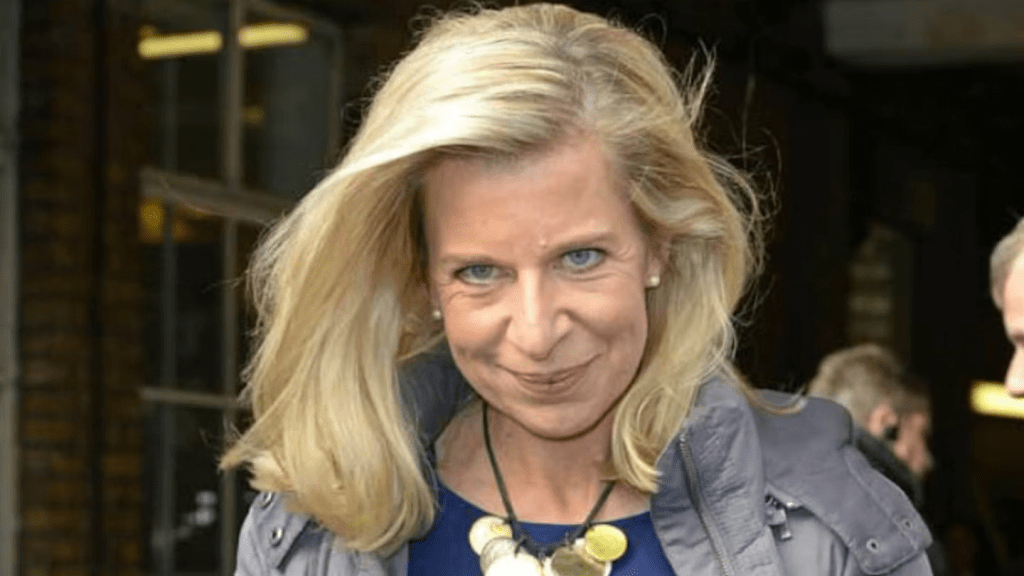
    The next topic was almost as controversial as the first namely, should the City Hall invite Katie Hopkins (pictured) to a gig at the hall? It appeared that some in the audience had not heard of her which is a kind of comment in itself. She came to fame on the BBC’s Apprentice programme and has since carved out a career for herself as a media person with a range of outspoken views. She deplores fat people and seems to have particular animus for women who stay at home after having a baby (having looked up a range of her quotes I discovered). The argument was essentially about the cancel culture which has gripped the universities. Some of her gigs have been cancelled it was claimed largely on public order grounds apparently.

    Did the booking and the purchase of tickets mean her views were endorsed by the hall and the
    audience? Some of the arguments hinged on KH being classed as right wing. It was a pity that more did not know of her comments because although they are, some might argue objectionable, few seem to be particularly right wing. The view that she was led to a question about whether a left wing comedian (Stewart Lee was mentioned) should be cancelled?

    It was argued that the City Hall was simply doing it for commercial reasons. One article was mentioned which caused much anger and many complaints was in the Sun where she referred to migrants as cockroaches. Objecting to her presence could be argued on acceptability grounds. It was divisive and these comments go against the values of our society. It was strongly felt by some that the City Hall should not be making money by inviting people whose act was built on causing offence.

    The counter argument was should we be concerned at offending people. Shami Chakrabarti has claimed that in the interests of free speech, we do not have a right not to be offended. Stand-up is sometimes outrageous, so where do you draw the line? The popular and award winning series on the BBC The Hour has been pulled and back issues are no longer available. It appears because it had low ratings rather than for any political or acceptability reasons (why back issues are not available is a puzzle though).

    In connection with a Tommy Robinson video, said to be professional, persuasive and manipulative, it was suggested that the educational system needs to catch up. There was a need for critical awareness to be introduced into Civics classes to help students grasp meanings and impacts. The Super Searchers Programme has been launched to enhance information literacy. However, it is run by Google – draw your own conclusions. An article in this month’s Byline Times discussed the topic of information with the familiar misinformation and disinformation, which we have discussed in several cafés, but added a third, malinformation which is using correct information for malign purposes.

    A point was made concerning humour and its use to mask prejudice. An article by George Monbiot in he Guardian discussed this aspect of humour by individuals like Rod Liddle who has a column in the Spectator. The article suggests that humour can be used as a form of ‘plausible deniability’ and as a cover for outrageous views such as getting rid of disabled people by starving them to death. Rod Liddle suggested bombing Glastonbury for some reason. Monbiot makes the point about Right v. Left: if a humourist suggested bombing the Conservative party conference there would be outrage. Suggestions of bombing Glasto are, well, humour. Can’t you take a joke?

    It was noted however that Bernard Manning made a career out of being outrageous and was hugely popular.

    An interesting idea was put forward about comedy: it is acceptable punching upwards at the powerful, less so punching ‘down’ to the powerless. Where that puts Bernard Manning’s many jokes about mother-in-laws is for you to decide.

    This was an example where debate could not settle a basic difference of view. For those who dislike unpleasant or divisive views being aired – whether or not wrapped up in humour – the likes of Katie Hopkins should not be promoted certainly not for profit. For others, however unpleasant, such people should be heard because the risk to free speech is a higher cause and one where we just have to put up with unpleasantness in its cause.

    Peter Curbishley

    The next meeting is on Saturday 13th September starting at 10:00 for 2 hours. We are grateful for the Library allowing us to use their space.

  • Democracy Café: March

    Café took place following tumultuous events in USA

    March 2025

    The Café started with a short introduction by the facilitator reporting back on the People’s Assembly which had been run the previous week. Around 40 attended, 50 all told, and the event secured good coverage in the local media. The next event is on 13 April and to secure a place contact mapotts53@gmail.com. We were also delighted to welcome a visitor from Horsham in E Sussex who is thinking of setting up a café in that town.

    We are grateful to Salisbury Library for their generous offer to use their space for our meetings.

    The Café took place in the week following the unseemly meeting in the White House between President Zelensky of Ukraine and President Trump and his team.

    The first question which won the vote was would we agree to a return of conscription? Conscription ended in the UK in 1963. Some saw it as having benefits for our youth: imbuing discipline in young people although it was noted that politicians were keen for it for other people’s children not their own. What was the difference between national service and conscription someone asked: there probably isn’t in reality. Were we desperate enough yet for this someone asked?

    The previous government had talked about a form of national service for school leavers. The problem was a hotchpotch of programmes for young people with little coherence for those who did not go to university, the less able and those with special needs. Someone felt that education had failed young people. Many parents don’t like their children going to school it was suggested and there had been a rise in home schooling. Echoing a discussion last time, there was little attention paid to the teaching of values they thought.

    A Quaker insisted that there was a right to object. He felt there was something of an obsession with military matters. In this context, it was noted that the nation faced threats which were not of a military nature eg cyber attacks, financial and bacteriological threats. We should be alive to these just as much as recruiting for the armed services. It wasn’t all boots on the ground. Someone who was a conscientious objector spoke of his service in an ambulance unit. Should we not aim for societies to live in a world without wars? It didn’t matter how you killed: what was the difference between a soldier in the field and someone sitting in front of a screen thousands of miles away pressing a button? Both had effects on the individual. Julian Assange and Wikileaks had revealed the extent of killing at a distance mainly by the US.

    The Quaker approach was questioned: what do they do to defend themselves? They did have a right to react (in reference to the Ukraine invasion) was the answer. The example of Einstein was mentioned who was in the US when Hitler came to power and decided not to go back to Germany. At that point he renounced his pacifism. After Hiroshima (which his discoveries in physics helped bring about) he became a pacifist again. The point being that people can change their minds.

    The government’s change of focus was introduced (the decision to reduce overseas aid funding to put more money into defence to reach 2.5% of GDP). We were never asked about this it was noted. It was suggested that it was a debate our leaders wanted us to have, to create enemies, even suggesting it was our leaders were the real enemies. The thinker and writer Prof. Mearsheimer was mentioned in the context of Ukraine (by now we had drifted away somewhat from conscription) and a lengthy essay on his thinking is available here. You will note that many do not agree with his views. Jeffrey Sachs was mentioned and his views about the eastward push of NATO and the idea that Americans had taken over the role the British Empire had in earlier times. His speech to the EU is a recommended read. Both suggested a need for our own foreign policy (divorced from the US was implied). The impetus behind the creation of the EEC, which was partly to end the centuries of wars which had taken place between European nations, has been forgotten it was said.

    It was suggested that every war since Vietnam has been a war of choice. This related to the references in the previous paragraph about America’s role in the world.

    Back to the plot and the problems within the armed services needed addressing. Issues of bullying and sexual harassment were common. This touched on the problem of retention of people within the services. The process in the Nordic nations and Switzerland where all able bodied men and women are required to do some kind of military service, Militärdienst (Switzerland). A recent referendum there voted 73% in favour of maintaining conscription.

    In relation to Ukraine, why weren’t we talking the language of diplomacy someone asked? The democratic process had been undermined at speed by the actions of Donald Trump someone said. There had been no time for the parliamentary process to have its say. The speed was deliberate it was suggested, the process of ‘flooding the zone’ (©Steve Bannon). It was a question of getting used to uncertainty.

    Well, we didn’t really answer the question! Conscription arose in times of war and that is unlikely as far as the UK is concerned. It might arise in connection with troops being sent to Ukraine a matter we did not directly discuss. Since the armed services have seen funding fall to seriously low levels and the standing army was at a very low ebb, maybe conscription might be needed. The debate circled around events in Ukraine which led us to part two …

    The second half kicked off with the question is the Trump approach to Ukraine the only practical one? There was a review of the current situation. Biden’s leadership saw no prospect of an end to the fighting; Putin has too much as stake to give up now especially after recent events; Trump is providing a solution which is not what Ukrainians want; he is forcing – or trying to force – Zelensky to concede. Debate.

    The similarities to the ’30s was mentioned and the policy of appeasement. A lot depends on Putin’s intentions someone thought: will he be satisfied with what he’s got (the implication being he won’t be)? Thousands have died but Trump’s way is giving Putin all the cards. We returned to some of the points in the first half debate. We were led to believe ‘Russia bad’ ‘America good’ but both had imperial ambitions as the above references will attest. The eastward push of NATO was a factor in recent events although it was noted that these new members wanted to join for their protection.

    Trump’s approach was purely transactional it was noted with an eye on securing mineral deals in Ukraine – no doubt at favourable prices – for American mining companies.

    Putin was fundamentally different someone noted, he was a liar and did not stick to agreements. The Minsk agreement was referred to which demanded nothing of Russia and was a precursor to the 2022 invasion. Remember the Novichok attack in Salisbury. At this point, Craig Murray’s take on the Skripal’s and Navalny was brought up, essentially disbelieving the received narrative of Putin ordering assassinations. We were reminded of the Katyn massacre of Polish soldiers carried out by the NKVD in WWII.

    It felt wrong it was said, that is to allow Russia to get away with invading which might lead to further actions in places like Moldova and the Baltic states.

    A bit of Russian history was mentioned namely that they were late to democracy. Attempts in the late nineteenth centuries to install a democratic system failed until the eventual October revolution took place. They had a sense of inferiority and this, it was suggested, was a factor in their thinking. They had been frequently invaded by Napoleon, Hitler and by western ‘White’ forces after the revolution. Ukraine had its own history and previous domination under the Tsars led to the policy of attempted Russification, suppression of the language and deportations of thousands of members of the intelligentsia.

    There was discussion, frankly difficult to summarise, around the eastward push of NATO being a factor, the role of the CIA and a quote by Kissinger ‘to be a enemy of the USA is dangerous, to be a friend, fatal’.

    The two debates circled around the same topic really and that was Ukraine. But we did discuss the changing perceptions of the USA brought into stark focus with the recent statements and actions from the White House. The USA was effectively an empire and had carried out a range of activities around the world to destabilise nations or leaders who tried to resist their power (see the books mentioned below). This power was used for the benefit of American firms, a factor plainly evident in Trump’s approach to Ukraine. So there is nothing new in his attitudes. This was forcing an urgent rethink of policy on defence and ultimately much else in Europe. Perhaps people were beginning to recast their view of America? Maybe we will see conscription …

    Next meeting on 12 April.

    Peter Curbishley


    Books mentioned:

    The Racket: a rogue reporter vs the American Empire, 2024, Matt Kennard

    The New Rulers of the World, 2016, John Pilger

  • Democracy Café, January 2023

    The first café of 2023 was held in our new venue – the Progress Café in Endless Street, Salisbury. Mark, the chair of Salisbury Democracy Alliance, welcomed everyone and explained that the Café was part of SDA’s activities which was to promote deliberative democracy, an issue which surfaced coincidentally in the second topic we discussed.

    The first topic which won the vote was about the conflict in Ukraine and how people thought it might end. The proposer of the topic quoted an article in the Global Policy Journal. The background to the conflict it was suggested is that the US wanted to draw Russia into a war in Ukraine which would drain it of resources over time and weaken the perceived intention of Putin to recreate the Russian empire, thus reducing its chances of becoming the dominant force in Asia. The US was also worried by the Russia/China link.

    Similarities were drawn with the war in Afghanistan where America and other western countries supplied weapons and military equipment sufficient to keep Russia bogged down there for years. The point was made that these wars are often testing grounds for equipment to see how well they perform on the battlefield. In Afghanistan, the Stinger missile was a crucial weapon which destroyed many Russian helicopters.

    The Ukraine war produced two surprises: first the tenacity of Ukrainian resistance and secondly, the weakness of the Russian military. It had been assumed that Russia’s military might would enable it to sweep through the country but the opposite had happened and its gains were limited. Although their army was strong in numbers, it was a conscript army and had weak NCO leadership.

    A key point was the actions of the West in the post Gorbachev era. It was suggested that Mrs Thatcher and President Reagan both failed to respond to the disintegration of the Soviet Union. Instead of developing something like the Marshall Plan, it gradually expanded NATO eastwards, taking in more and more members, up to the border with Russia. In other words, the invasion was a kind of reaction to this eastward push by NATO.

    Another point was that Putin saw how the US and other NATO countries abandoned Afghanistan in some haste. They also failed to respond to Russia’s original invasion of Crimea and were largely mute with its support for the brutal campaign by Assad in Syria. They are likely to have concluded that the West were unlikely to do much if a full-scale invasion of Ukraine was undertaken. In this connection, we were reminded that the Crimean Oblast was handed over to Ukraine in 1954 by Khrushchev.

    How will it end? One suggestion was that the voice of the people (by which it is assumed the Russian people) must be heard. How? was the question in a state where opposition is not allowed and the media was tightly controlled. How long the western public will put up with the expenditure in view of other well-known pressures on the public purse at present? Will anyone be held to account for the war crimes?

    A theme, which was a kind of leitmotiv to the discussion, was that the media tended to underplay the role and responsibility the US has had in the current war. The deliberate confrontation with Russia particularly with the eastward push of NATO, and the desire to weaken the state and to depose Putin and the policy of giving just enough weaponry to the Ukrainians but not (it is alleged) sufficient for them to win it are all aspects of note. This is not to downplay or excuse Russia’s actions nor the war crimes which it is alleged they have committed.

    The second half discussion was on the suitability of our MPs and how they are selected. It would be fair to say that variations of this topic have been debated over the years reflecting, perhaps, the disquiet over poor decision making and some disastrous policy mistakes. The introducer gave a tour d’horizon of the problems as he saw it. He gave examples including the Iraq invasion and gambling legislation by Blair; the referendum by Cameron and more recently Johnson and Truss. In his view, MPs should be properly paid, truly independent and provide evidence and reasons for their policies and decisions. He also suggested their should be regional assemblies although he was reminded there were proposals to introduce these around 15 years ago and the legislation was never proceeded with.

    Some suggested that PR was a way forward as this might help smaller or newer parties gain seats. We were reminded that UKIP secured nearly 4 million votes in 2015 but gained not a single seat. Not everyone was convinced by PR however claiming that it risked have candidates who were party hacks and it might prevent independents getting elected.

    One problem was that MPs were expected to be all things to all men. One minute they were in their surgery dealing with a constituent worried about a pot hole outside their house, and the next expected to deal with affairs of state.

    On the question of pay, the issue of second jobs was mentioned. Some MPs have significant commitments, and sizeable earnings, from this activity and this raises the question, where do their loyalties lie (and when do they get the time to do the job they are elected to do?)? Linked was the question – some might say scandal – of lobbying which was on a huge scale. Isabel Hardman’s book ‘Why we get the wrong politicians‘ which painted a fairly grim picture of life as an MP.

    The legal system was mentioned and the jury system where a group was selected more or less at random, to hear a case and decide on guilt or otherwise. Could this not be a model for politics? We were reminded that one of the objectives of SDA is just such an idea – a citizens’ jury. This would review a problem in detail, using experts as necessary, and recommend a course of action. We had tried to introduce this idea with WC and Salisbury City Council, so far without success.

    One telling point was made however. We can talk about selection of MPs; lobbying; second jobs, and the poor quality of so many MPs, but the fact remains that it is we who select them at election time. Do we not get the MPs we deserve? How do we encourage the electorate to vote for the right person, although as Hardman points out, we are all too often presented with a candidate already selected by the local party?

    We were reminded of Walter Lippman and his phrase ‘the Bewildered Herd’. Lippman had a low opinion of democracy and assumed many people were too disengaged to understand the complexity, made worse by poor journalism.

    Peter Curbishley

    Books mentioned:

    Why we get the wrong politicians, Isabel Hardman, 2019, Atlantic Books.

    Putin’s People: how the KGB took back Russia and then took on the West, 2020, Catherine Belton, William Collins.

    Mistakes were made but not by me, 2007, Carol Tavris & Elliot Aronson, Harcourt.

  • Democracy Café: March 2022

    Just over 20 people attended the café in Brown Street with a handful on line via Zoom. Better microphoning improved matters but there were still a few technical hitches. The meeting took place about two weeks after the Russian invasion of Ukraine and this issue popped up several times during our debate.

    The first topic was about gender balance and should there be more balance in our national institutions? A common theme emerged in the discussion was that of culture. For example, the first point to be made is that two of our cabinet ministers at present are Priti Patel and Liz Truss, neither of who inspire much in the way of confidence. Indeed, Patel is under fire at present because of her dilatory approach to Ukrainian refugees, few of whom are able to make it to the UK. Do we want more women like this? The riposte was immediate: we are quick to criticise poorly performing female cabinet ministers but what about failing or inadequate male cabinet ministers? One thinks of the dismal performance of the past education secretary who has recently been knighted and what about ‘failing Grayling?’ Secondly, who appointed them but, a man, namely Boris Johnson. The culture point however was that men created a system which leads to people like Truss and Patel. This was not developed but it was implied that women who succeed in these roles have to assume male characteristics and behaviours to do so. The overall (poor) quality of our politicians was noted.

    It was argued that one of the key differences was the differing life experiences between men and women. It meant those in power – predominantly men – simply do not have the experience or personal knowledge of what it is like to be female in our male dominated society. Issues of safety in our streets, being out at night, the attitudes of police towards women and so forth were unknown to them. It applied to those with disabilities and people of colour it was noted. However, what about Margaret Thatcher? When she was made prime minister, it was widely thought she would bring a female perspective to the role but the opposite was the case. No woman was appointed to her cabinet and she took little interest in social issues although she never quite said ‘there is no such thing as society’. The issue of better involvement and decision making was part of SDA’s desire to have a Citizen’s Assembly in Salisbury and the Maltings development, Fisherton Street and the Library were cases in point.

    Back to Priti Patel and co, the point was made that women had to work a lot harder to get anywhere. The discussion moved onto women’s role in childcare which was generally different although the point was made that more men were giving up careers if their wives or partners were doing well. It meant that when they (women) re-entered the workforce after their children had grown up they had had less experience of outside activities (and thus were disadvantaged I think was the point). The need for more, and more affordable, childcare was emphasised the absence of which was a real impediment to women (mostly) being able to integrate into the workforce.

    Someone with a background in education said that men were largely missing from primary school teaching. This led onto a discussion about women being more about nurturing, but, it was counter argued, wasn’t this more about culture than some intrinsic gender difference? It was assumed to be so therefore it came to be. The younger generation have different attitudes and are generally more flexible about these supposed roles. Another view was that it all went back to hunter-gatherer days when men were the ‘protectors’ and although it wasn’t quite clear protection from what: one assumes it was wild beasts. Some women might feel that now wolves and bears have gone it’s men they need protecting from …

    Baboon behaviour was put forward to challenge our views of gender stereotypes. Apparently, male baboons establish positions around the outside of the flange whereas the females cluster in the centre. But, when real danger appears, the male baboons run away whereas the females fight to the death. As if by chance, a new book has just been published entitled: Bitch: A Revolutionary Guide to Sex, Evolution and the Female Animal by Lucy Cooke published by Doubleday. The Guardian review ended by quoting the author saying ‘Much of the distorted science [we] have been taught was shaped by the values of a certain kind of man. To change that … we need more diverse scientists: “a mixture of sexes, sexualities, genders, skin colours, classes, cultures, abilities and ages”. ‘Only then, it seems, will we be able to see the female experience in nature for what it is: “variable, highly plastic”, and “refusing to conform to archaic classifications”. Issue 24, 12 March 2022.

    There were many during the course of the discussion who doubted whether there were great differences between males and females. A lot of it was a kind of cultural overlay: women’s roles were set out for them, how they should behave, what they should wear and what they should do: ‘a woman’s place is in the home’ for example. Women then had to conform to these norms and stereotypes which had then become self-fulfilling. Women should stay at home and look after the children which meant that they were suited to nurturing: basically a circular argument. Meanwhile men were off fighting those pesky wolves and bears. I hope this is a fair summary of what people felt.


    Part two was a discussion around Ukraine and the effects on nationalism. Parallels with the World Wars was obvious. Powerful anti-German feelings were evident in both wars with German homes and businesses attacked as if all Germans were complicit. It was noted that all Germans (in Germany) had to tread carefully once the Nazis came to power – it was more or less obligatory to join the Hitler Youth for example.

    It did seem though that so far at least, people were distinguishing between ordinary Russians and President Putin. Russians were not all being tarred with the same brush. The attacks on Germans during the wars was not being repeated. It was recognised that Russians were largely being kept in the dark because of the tight media and internet control exercised by the regime. The wildly improbable narrative that Ukraine is being led by a Nazi regime was nevertheless believed by many Russians apparently.

    The interesting point was made that sanctions will be hurting ordinary Russians whereas the effects on the elite will not occur for some time.

    Back to the question: isn’t the Ukraine war making us more international in our outlook? It had stiffened NATO, Finland and Sweden were both considering joining and the UK was aligning itself closely with Europe. Whatever happened to Brexit?

    The point was powerfully made about what exactly is a ‘Nation’? Just considering that part of the world, borders have changed over the past 100 years. Poland has moved east and then west, the Austro-Hungarian Empire had gone altogether and whatever happened to Prussia? Czechoslovakia had been created and was no more. Millions lived in countries who spoke languages other than the national language: Polish was spoken in west Ukraine for example. The idea of a nation as some kind of fixed immutable entity was a nonsense. They were like lines drawn on a beach, when the tide of history came in, they were no more.

    It was noted that Russia had never (in recent times) been successfully invaded although they had suffered terrible privations, as in the siege of Leningrad. Ukraine on the other hand, still had memories of the German invasion. Ukraine also suffered a terrible famine purposely engineered by Stalin. Russia also think it was they who won the second World War which they call the great patriotic war. Someone said we need to do more to understand Putin’s standpoint.

    The discussion moved onto refugees which in an eerie way took us back to Priti Patel. Other European nations were welcoming refugees with open arms whereas the UK is … not. There were some who doubted whether they were still proud to be British. Even the Daily Mail is criticising the government although we do have to note that the paper has spent years and thousands of column inches reviling refugees and immigrants.

    A three stage response was suggested 1. fight or flight 2. us and them and 3. thinking about ethical values.

    Finally, and certainly hopefully, was the question, are young people less nationalistic? The answer seemed to be an emphatic ‘yes’ and instances were quoted of various offspring who had married people from other countries and that this was not seen as exceptional.

    Two interesting discussions and a recurrent theme was the differing attitudes between the generations which should give us hope for the future.

    Peter Curbishley