Tag: Wiltshire

  • People’s Assembly

    First People’s Assembly held and was a great success

    March 2025

    [UPDATE: 14 April. The Football Club will now be the location for the third People’s Assembly on 1 June]

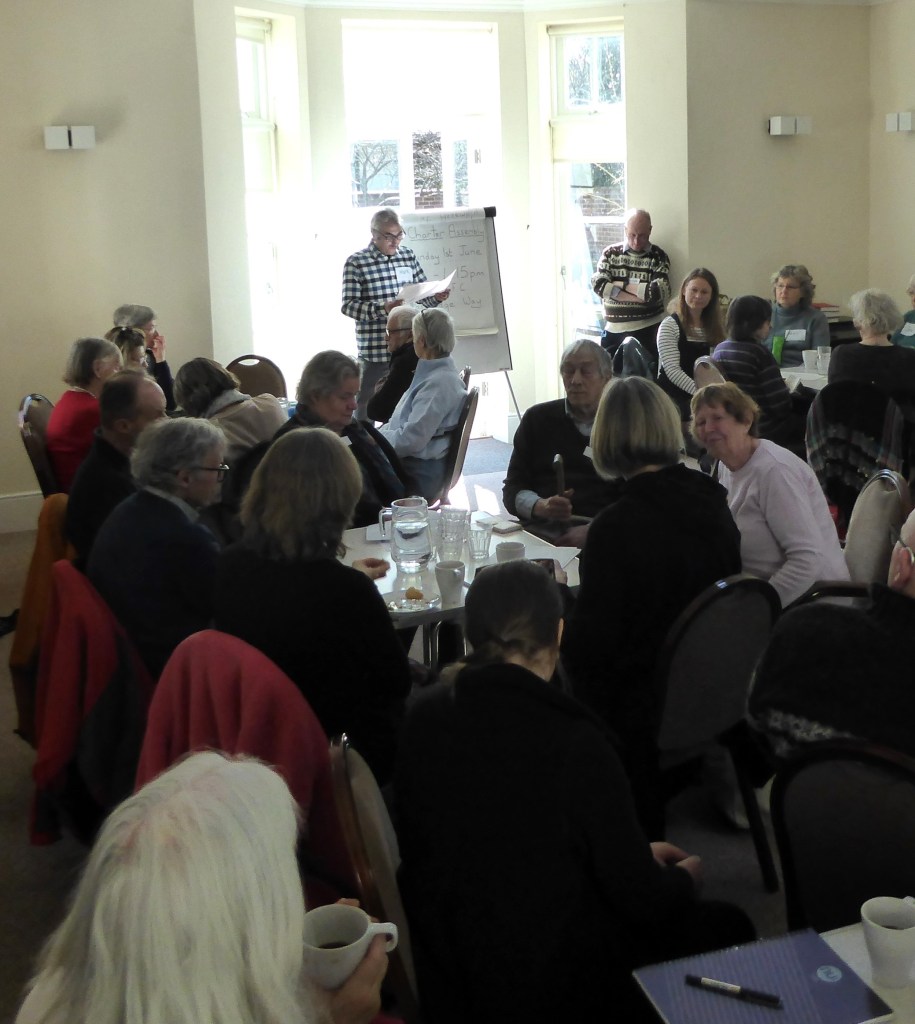
    We held our first People’s Assembly on Saturday March 1st at which around 40 attended with a further 10 of us, with spirited debates on some of the key problems which face Salisbury. The idea is part of the Assemble movement and after two more of these assemblies are held, our final suggestions will go to the national event to be held in July.

    To some extent, people have lost some faith in the political process. We have elections and we listen to speeches and read manifestos, but in reality, what we the people think seems to matter less and less. It is media interests – many of them based in America – and commercial firms which seem to call the tune. Elon Musk and his various outrageous and incorrect posts about grooming gangs is a recent example. His statements forced the government’s hand and the Home Secretary has announced an enquiry. So an American has driven policy, not the people who voted for the government last year. The malign role of the Murdoch media has been well aired.

    It is also timely as the struggle to reform the House of Lords continues. This archaic institution which is largely white and elderly, is resisting efforts at reform, reform that is long overdue (long as in centuries). This is just one of the campaigns to encourage the voice of ordinary people to be heard.

    The idea of these meetings is first, to ask people to say what they think the problems facing Salisbury are and second, to suggest solutions. A variety of ideas and problems emerged including concerns about housing issues. People felt aggrieved that developers were able to dodge their planning obligations by not providing sufficient affordable homes. Building homes that weren’t fully insulated was another complaint as was not allowing building on the flood plains. Housing estates going up around Salisbury without infrastructure such as medical centres was another concern.

    More council built homes was suggested. Perhaps the effects of ‘right to buy,’ the flagship policy of the Thatcher era, are now being understood. We should remember that it was originally a Labour party policy but the problem when it was introduced was not allowing LAs to use the receipts to build more homes.

    Transport was a topic of interest and people wanted to see a more comprehensive and realistic transport plan with car free zones, people friendly routes and more cycle ways. More pedestrianisation was also suggested in Salisbury.

    Perhaps a surprising suggestion was for Salisbury to have a College for the Performing Arts which would complement the Playhouse and provide opportunities for young people to gain skills in this important part of our society.

    Most found the afternoon interesting and certainly there was a lot of earnest debate in each of the groups. Some were disappointed at the lack of opportunity to debate or explore some of the problems and the suggestions being put forward. They felt it was a tad rushed and they would have liked more time. Another worry was that some good ideas seem to get lost in the voting process. But hey, Rome wasn’t built in a day. We are looking carefully at the timings and overall timescale and may well alter things for the second meeting to be held on 13 April.

    Another issue which emerged was the status of Salisbury. Being a parish, means it has only limited powers to do make changes. It also meant focusing the debates and suggestions quite difficult since where did the responsibility lie?

    Some photos of the event are below. Clockwise from the left: Mark Potts; plenary session; a speaker feeding back from her group; groups debating their topics; assembling before the event.

    The next meeting takes place on Sunday 13 April at St Gregory’s Hall (SP1 2SF, St Gregory’s Avenue off the Devizes Road) at 2pm. It is free to attend with a parting collection. The third is 1st June at the Football Club. You can come to either or both. To register your interest please leave a note here or contact mapotts53@gmail.com.

    Be part of a new force and make your views known.

    Peter Curbishley

  • Chalk and Cheese, and Save our Salisbury

    February 2021

    In this month’s Democracy Café we debated the question of a land tax a proposal which has appeared from time to time – most recently in the 2019 Labour Party manifesto – but it never lives to see the light of day.  Part of our discussion was taken up with how the Normans established the pattern of ownership in England following the invasion.  Some families who own estates, can trace their lineage back to the Normans even today.

    I was reminded during the discussion of a book published in 1979 by J Martin Shaw (not the actor) entitled Rural Deprivation and Planning, who used to be the County Planning Officer for Norfolk (where coincidentally the actor comes from) who wrote a book about shire county councils and how they worked up until quite recently.  Unfortunately, I lent the book to someone and I cannot find it or its title on the internet.  He described how shire counties like Norfolk used to be run essentially by its landed interests.  For them, a rural county was an ideal form of life.  They had the time and money to be able to take part in local politics and from their ranks, many county and district councillors were elected.  Those who worked the land could not get, or afford, the time off and so the whole issue of rural poverty and disadvantage never got a hearing.

    Wiltshire was similar in many respects.  Wiltshire is unique in that it is the only county not to have a university except for tiny Rutland.  What is now the University of Bath was intended for Wiltshire.   Someone close to the negotiations at the time said the idea of a university was not universally welcomed by those in power in County Hall.  Likewise, the dire state of roads in the county was also as a result of the landowning interests not wanting or needing to improve communications.  They believed in small government, long before the phrase became popular, and county council meetings started at 2pm with the intention of ending by 3pm at the latest.  After a good lunch of course.  As the main aim was to do little and invest even less, this was not difficult.  A senior highways engineer told me they did not want improved communications or roads because it would encourage their workers to look elsewhere.  I have no way of knowing if this was true but it was said with feeling.

    I can see echoes of this thinking in the decisions of county hall even today.  A kind of remoteness and an approach based on ‘we know best’.  When a group of us met the leader of the County Council at the beginning of austerity, their easy acceptance – relish even – for cutting funds in the county was very evident.  There were words of regret but the readiness to cut funding was easy to see.  They talk ‘consultation’ but this is more ‘this is what we plan to do, do you like it?  No?  Tough, that’s what’s been decided.’  When the idea of citizens’ assemblies is put to them, the idea is politely received then during a public meeting in the Guildhall, it is nowhere to be seen.

    There is now a move to get more independents elected onto the City Council.  I suspect this is born of a frustration with continued mismanagement, not especially by the City Council itself, but by their paymasters in Trowbridge.  Will this succeed?  As a Scottish colleague of mine used to say ‘I ha’ ma’ douts.’  One problem is a collection of independents is not a party almost by definition.  Will they be able to collaborate sufficiently to counter the established parties?  Maybe, maybe not.

    Secondly, the City Council is a parish council.  This is really an absurd state of affairs.  I was never a fan of the district council but at least it was local.  A city whose administration is a parish council: bizarre.

    Chalk and Cheese?  This is probably a Wiltshire saying coming from when, in the immediate area of Salisbury, they could only rear sheep on the chalk.  West and north they could raise cattle and produce cheese.  Hence in Salisbury market there were two parts and the cheese was sold outside what is now HSBC bank.  It seems to be a metaphor for the state of affairs we have in the county today with decisions taken in the north of the county and often seem divorced and irrelevant to the south.

    Perhaps we need to think differently and divide Wiltshire into two counties: North Wiltshire and South Wiltshire?  North would continue to run from Trowbridge – after all they seem to have spent millions on the building there.  The south would need to be decided and not necessarily Salisbury.  Save our Salisbury could perhaps direct part of their efforts to this endeavour.  It is likely to reap better dividends and more locally based local government than we have now.

    It leaves the baleful influence of the landed interests still quietly evident.  They can continue, behind the scenes, to select their own.  The only way to counter this is to enliven local democracy.  More independents in a South Wiltshire County Council which has the powers of a county, could make a real difference.

    Peter Curbishley

    Updated 10 March

  • Lib Dem organised meeting

    If you attended the meeting yesterday evening (27 Jan) with 30 others organised by the Lib Dems, you may have seen reference to the SDA. The speaker spoke of citizens’ assemblies mentioning the Northern Ireland example in particular.

    We are keen to support this idea so anybody keen to support it is welcome to keep in touch. We want to establish the principle in Wiltshire. The meeting expressed considerable dissatisfaction with politics both local and national and the speaker, Dr Ian Kearns was encouraging us to get active. He mentioned the Frome Flat Pack project which has been written up here.

    A report by Dr Kearns can be read by following this link.